

The urine drug screen CPT codes most labs and practices bill are 80305, 80306 and 80307, and the right one depends on how the screen is read rather than how many drugs it covers. All three are presumptive codes, which means they identify possible drug use and are billed once per date of service.
Older references, including the earlier version of this page, often described 80306 and 80307 as definitive tests. Some still list codes that were retired years ago, and that confusion keeps causing denials. What follows is a corrected guide to presumptive screen coding, along with the alcohol codes billed beside it and the point where a screen turns into a definitive test. Practices that want this handled outside the office can look at our toxicology billing services.
Key Takeaways
- 80305, 80306 and 80307 are all presumptive drug screen codes. They are separated by how the test is read, not by the number of drug classes.
- Each code is billed as one unit per patient per date of service, whatever the number of drug classes or devices used.
- 80307 covers instrumented chemistry analyzers such as immunoassay or mass spectrometry screens, and it is not a definitive test.
- Definitive drug testing uses 80320–80377 for most commercial plans and G0480–G0483 for Medicare.
- 80101, 83992 and the G0431, G0434 and G0477–G0479 screens are retired codes and will be rejected.
Presumptive Drug Screen Codes 80305, 80306 and 80307
A presumptive test shows whether a drug class may be present. It is the screen that comes first, and its code is chosen by the reading method.

80305 for Direct Optical Observation
80305 covers presumptive drug testing, any number of drug classes and any number of devices, read by direct optical observation only. Typical examples are dipsticks, cups, cards and cartridges read by eye at the point of care. Sample validation is included when performed.
80306 for Instrument-Assisted Reads
80306 covers the same kinds of devices when the result is read with instrument assistance, such as a cup or cassette placed in an optical reader. The device is often identical to an 80305 cup. The difference is that an instrument, not a staff member, interprets the line.
80307 for Instrumented Chemistry Analyzers
80307 covers presumptive testing performed on instrumented chemistry analyzers. That includes immunoassay methods such as EIA, ELISA and EMIT, chromatography such as GC or HPLC, and mass spectrometry with or without chromatography. Even when a mass spectrometer is used, the test is reported with 80307 if it is used as a screen without the calibration and controls of a definitive method.
One Unit per Date of Service
Each presumptive code is billed once per patient per date of service, regardless of the number of drug classes screened or devices used. The Medicare Billing and Coding article for urine drug testing states the one-unit limit applies no matter which provider bills it.
Choosing the Right Presumptive Code
Most coding errors on drug screens come from matching the code to the drug count or the specimen instead of the method.
Read Method, Not Drug Class Count
A 12-panel cup read by eye is 80305, and a 5-panel cup read by an optical analyzer is 80306. Neither the number of panels nor the number of drug classes changes the code or adds units. Make sure your fee schedule and charge master do not attach unit counts to panel sizes.
CLIA Certificates and Modifier QW
The billing provider’s CLIA certificate has to cover the complexity of the test performed. Waived cups and dipsticks billed to Medicare carry modifier QW, and claims from a practice holding only a certificate of waiver will be denied for 80307 testing on a moderate or high complexity analyzer.
Setting and Payer Limits
Some commercial plans pay 80305 and 80306 in physician offices but pay 80307 only to clinical laboratories. Others limit the number of presumptive screens per member per year. Check each payer’s drug testing policy before adding an analyzer to an office lab.
When a Screen Moves to Definitive Testing
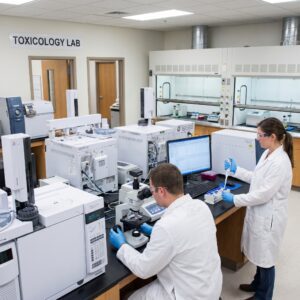
Definitive testing identifies specific drugs and metabolites, usually by LC-MS/MS or GC-MS with drug-specific calibration and internal standards.
What Makes a Test Definitive
A definitive test names the drug or metabolite, often with a quantitative result. It is usually ordered to confirm an unexpected presumptive result or to test for a drug that has no reliable screen.
CPT Codes 80320 to 80377
The CPT definitive range assigns one code per drug or drug class. 80320 is alcohols, 80361 is opiates and 80365 is oxycodone, with 80375 to 80377 for drugs that have no specific code. Each code is reported once per date of service regardless of how many analytes in that class were measured.
Medicare and Payers That Use G Codes
Medicare does not accept 80320–80377 and pays definitive testing through G0480 to G0483, tiered by the number of drug classes, or G0659 for simpler methods. Some commercial and Medicaid plans have moved to the G codes as well. Our guide to definitive drug testing and G0480–G0483 billing covers the tiers and the medical necessity rules in detail.
Alcohol Testing Codes
Alcohol has its own codes outside the presumptive panel, and the right one depends on the specimen and the method.
82075 for Breath Alcohol
82075 covers ethanol measured in breath. It is the code for a breathalyzer test performed in a clinic or treatment program.
82077 for Immunoassay and Enzymatic Methods
82077 covers ethanol in any specimen except urine and breath when measured by immunoassay or enzymatic methods such as alcohol dehydrogenase. It is used for many serum and whole blood ethanol tests run on a chemistry analyzer.
Definitive Alcohol Codes
Ethanol measured by a definitive method such as gas chromatography falls under 80320 for alcohols. Alcohol biomarkers such as ethyl glucuronide and ethyl sulfate tested definitively are reported with 80321 for one or two biomarkers or 80322 for three or more. A urine EtG immunoassay screen run on an analyzer is part of the 80307 presumptive service.
Retired and Misused Toxicology Codes
Searches and older charge masters still reference codes that no longer exist, and claims that use them are rejected outright.
Codes Deleted Years Ago
80100, 80101 and 80102 were deleted at the end of 2014, along with drug-specific codes such as 83992 for phencyclidine. CPT replaced them with 80300 to 80304 for 2015 and 2016. Medicare kept its own screens over the same period, G0431 and G0434 in 2015 and then G0477 to G0479 in 2016. All of those were deleted on January 1, 2017, when 80305 to 80307 took effect.
Codes Often Listed by Mistake
82378 is carcinoembryonic antigen, a tumor marker, and has nothing to do with drug screening. 82542 covers column chromatography or mass spectrometry for non-drug analytes, so it should not be used for drug testing. Our overview of laboratory billing CPT codes lists the general chemistry codes these are sometimes confused with.
Cleaning Up the Charge Master
Search your charge master and order sets for any retired drug codes and map them to the current presumptive or definitive code that matches the method. Interfaces from older LIS builds are a common source of deleted codes reaching the clearinghouse.
Orders and Documentation for Drug Screens
Presumptive screens are inexpensive, but they still need an order that supports them.
What the Order Should Include
Medicare requires a written order from the treating provider that lists the drugs or drug classes to be tested. When the performing lab is not the ordering practice, the lab keeps a copy of the order with the results.
Testing Frequency
Payers expect screening frequency to follow the patient’s treatment phase and risk level, documented in the plan of care. A fixed schedule applied to every patient regardless of risk is a common audit finding. Our article on Medicare reimbursement for toxicology testing explains how Medicare reviews these claims.
Diagnosis Codes
Link the screen to a diagnosis that explains it, such as Z79.891 for long-term opiate analgesic use or a substance use disorder code from F11 to F19. Pre-employment and court-ordered screens are not covered by Medicare or most health plans and should be billed to the employer or the patient.
Common Urine Drug Screen Billing Errors
These errors account for many rejected drug screen claims, and each can be fixed in the claim edits.
Billing Units per Drug Class
Reporting 80305 or 80307 with one unit for each drug class is one of the most frequent drug screen errors. The correct unit count is one per date of service.
Coding a Screen as Definitive
An immunoassay screen billed with 80320 to 80377 or a G code will be denied or recouped, because those codes require a definitive method. Code the method that was used, not the result it produced.
Separate Charges for Specimen Validity
Creatinine, pH, specific gravity and oxidant checks are included in the presumptive codes. Billing them with separate chemistry codes is treated as unbundling.
Toxicology Lab Billing FAQ
What is the CPT code for a urine drug screen?
A urine drug screen is billed with 80305, 80306 or 80307 depending on how it is read. 80305 is for cups or dipsticks read by eye, 80306 is for devices read by an instrument and 80307 is for screens run on a chemistry analyzer.
What is CPT code 80305?
CPT 80305 is presumptive drug testing for any number of drug classes, read by direct optical observation only, such as a cup, dipstick or card. It includes sample validation and is billed once per date of service.
What is the difference between 80305 and 80306?
Both cover presumptive tests on devices such as cups and cartridges. 80305 is used when staff read the result by eye, and 80306 is used when an instrument reads the device.
Is CPT 80307 a urine test?
80307 is most often performed on urine, but the code is not limited to one specimen type. It covers presumptive testing on an instrumented chemistry analyzer, which can also run oral fluid or blood specimens.
Can 80307 and G0480 be billed on the same date of service?
Medicare allows a presumptive code and a definitive G code on the same date of service when the definitive test is medically necessary, such as confirming an unexpected screen result. The order and record should show why the definitive test was needed.
What does CPT 80320 cover?
CPT 80320 is a definitive drug testing code for alcohols, such as ethanol measured by gas chromatography. It is not a screening code, and Medicare uses G codes instead of 80320 for definitive testing.
What replaced CPT 80101?
80101 was deleted at the end of 2014. Presumptive drug screening is now reported with 80305, 80306 or 80307, which took effect on January 1, 2017, after a two-year period under 80300 to 80304.
Toxicology Lab Billing Support From Medwave
 Drug screen claims are small, and that is why errors in them pile up. A unit error on a single cup costs little. The same error on every patient for a year can trigger a payer review that reaches back across all of it.
Medwave has supported 15,000+ providers, and our medical billing team submits claims at a 98% clean claim rate. For toxicology labs and office-based testing programs we build claim edits around read method and unit limits, then match each payer to the code set it expects. Credentialing a new lab with payers averages 85 days. Use the form below to have us review your drug screen claims.
Disclaimer: This article is provided for informational purposes only and does not constitute legal, billing or financial advice. CPT codes and payer policies change, and providers should verify current requirements with each payer before applying any coding approach. CPT® is a registered trademark of the American Medical Association.

Co-Founder and COO of Medwave, bringing more than 25 years of hands-on experience in healthcare revenue cycle management, payer contracting, and medical credentialing.