

Toxicology reimbursement depends more on how definitive drug testing is ordered and documented than on any other part of the lab claim. Presumptive screens are simple to bill and pay modestly, while confirmatory testing carries most of the revenue and nearly all of the audit risk.
Whether you run a reference lab or a point-of-care program inside a pain practice, the same few decisions determine whether a toxicology test gets paid. The payer has to receive the code set it expects, at the tier the results support, with an order that explains why this patient needed the test that day. This guide works through those decisions for Medicare, Medicaid and commercial plans so your toxicology reimbursement holds up when a payer asks for records.
Key Takeaways
- Medicare pays definitive drug testing through HCPCS G0480–G0483 and G0659, never through CPT 80320–80377.
- G0480–G0483 are tiered by the number of drug classes tested, and only one of them can be billed per patient per date of service.
- Presumptive codes 80305, 80306 and 80307 are each reported once per date of service, no matter how many drug classes the screen covers.
- Commercial plans are split, and some now require the G codes in place of 80320–80377, so the code set has to be chosen by payer.
- Definitive testing needs an individualized order tied to the patient’s history, presumptive result or treatment plan. Standing panels ordered the same way for every patient are a leading cause of recoupment.
Where Toxicology Lab Revenue Is Won or Lost
Drug testing splits into two stages with very different billing profiles. Presumptive testing identifies possible drug use with immunoassay cups or chemistry analyzers. Definitive testing identifies specific drugs and metabolites with methods such as LC-MS/MS or GC-MS.
The Presumptive Stage
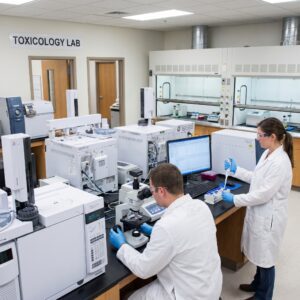
Presumptive screens are coded with 80305 for direct optical observation, 80306 for instrument-assisted optical reads and 80307 for instrumented chemistry analyzers. Each is billed once per date of service. Payment per screen is low, so the presumptive stage rarely drives revenue, but it often justifies the definitive test that follows. Our companion guide on CPT codes used in toxicology lab billing covers the presumptive codes and urine drug screen panels in detail.
The Definitive Stage
Definitive testing is where code selection and medical necessity documentation meet. A single misread of the payer’s code set or the drug class count can turn a payable confirmation into a denial, and repeated patterns can trigger a prepayment review. The rest of this guide focuses here.
Medicare Definitive Drug Testing With G0480 Through G0483
Medicare does not recognize CPT 80320–80377 for drug testing. Labs bill one HCPCS G code per date of service, selected by the number of drug classes tested and by the quality of the method used.
Counting Drug Classes for the Right Tier
The four tiers for definitive testing that uses drug-specific calibration, matrix-matched quality control and stable isotope or other recognized internal standards are listed below.
- G0480 for 1 to 7 drug classes, including metabolites if performed
- G0481 for 8 to 14 drug classes
- G0482 for 15 to 21 drug classes
- G0483 for 22 or more drug classes
Count drug classes, not individual analytes. Oxymorphone reported alongside oxycodone is a metabolite within the same class, so it counts once toward the tier. Build the class count into your LIS so the code is assigned from the results that were reported, not from the panel name on the requisition.
One G Code per Date of Service
G0480–G0483 are mutually exclusive on the same day. When a reflex adds classes to a confirmation already in process, the lab bills a single code at the tier matching the combined class count. Billing G0480 and G0481 together for one patient on one day is a guaranteed edit failure.
When G0659 Applies
G0659 covers definitive testing for any number of drug classes when the method lacks drug-specific calibration, matrix-matched quality control or the internal standards that G0480–G0483 require. It is billed once per date of service and pays less than the tiered codes. Labs using simpler definitive methods should code G0659 rather than reaching for a tier their validation cannot support.
Specimen Validity Is Bundled
Creatinine, pH, specific gravity and oxidant checks performed to confirm the specimen was not adulterated are included in both the presumptive and definitive codes. Billing them separately with chemistry codes is a common overpayment finding. Our overview of how Medicare reimburses toxicology testing explains the fee schedule mechanics behind these codes.
Commercial Payers and the 80320–80377 Code Set
Many commercial plans and Medicaid programs still accept CPT definitive codes, but that is changing payer by payer.
How CPT Definitive Codes Are Reported
The 80320–80377 range assigns a code to each drug or drug class, such as 80320 for alcohols, 80361 for opiates and 80365 for oxycodone. Each code is reported once per date of service regardless of how many analytes within that class were measured. A broad confirmation panel can produce a long claim, which is why commercial payers apply class caps or per-day limits in their drug testing policies.
80375, 80376 and 80377 for Drugs Without a Specific Code
These codes cover definitive testing for drugs or substances that have no dedicated code in the range. 80375 covers 1 to 3 such substances, 80376 covers 4 to 6, and 80377 covers 7 or more. They are meant for analytes outside the named classes, so using them for a drug that already has its own code will be denied on review.
Payers Switching to G Codes
A growing number of commercial and Medicaid managed care plans now require G0480–G0483 instead of CPT definitive codes. Health Net in California stopped paying 80320–80377 for dates of service from October 1, 2026, and claims sent with the CPT codes are denied. Check each contracted payer’s drug testing policy before assuming the CPT range still applies.
Medical Necessity Rules That Decide Definitive Claims
Coding errors cause a share of toxicology denials, yet most recoupments trace back to orders that did not support the test.
Individualized Orders Instead of Standing Panels
Medicare contractors, through policies such as the MolDX Drug Testing LCD (L35006) and the Controlled Substance Monitoring and Drugs of Abuse Testing LCDs, treat blanket orders and identical panels for every patient as not reasonable and necessary. The ordering clinician should select the drugs or classes based on the patient’s prescribed medications, risk assessment and presumptive results. A requisition that lists a custom panel with a single checkbox will not meet that standard.
Reflex Testing After a Presumptive Result
Definitive testing is supported when a presumptive result is unexpected, when it conflicts with the patient’s account or prescription list, or when no presumptive test exists for the drug in question. Document the triggering result or the reason no screen was possible. A negative screen for a prescribed opioid is a classic justification, since it may signal diversion or nonadherence.
Testing Frequency by Clinical Setting
Payers expect frequency to follow the patient’s risk and treatment phase. Early substance use disorder treatment usually supports more frequent testing than stable long-term opioid therapy in a low-risk patient. Write the frequency into the treatment plan and revisit it when risk changes, because a fixed weekly or monthly schedule applied to every patient invites a frequency audit.
Diagnosis Coding That Supports the Order
Pair the claim with diagnoses that explain the test, such as Z79.891 for long-term use of opiate analgesics or a code from the F11–F19 range for substance use disorders. Generic screening codes alone rarely carry a definitive claim through a payer’s medical policy edits.
Lab Fee Schedule Pressure and Pricing Decisions
Medicare pays drug testing under the Clinical Laboratory Fee Schedule, and commercial contracts often reference those rates.
Where PAMA Stands
The scheduled Medicare lab cut for 2026 was postponed by Section 6226 of the Consolidated Appropriations Act, 2026, and PAMA reporting reopened with private payer data from January through June 2025. Without further action from Congress, each test’s rate can fall by up to 15 percent per year in 2027, 2028 and 2029, based on the newly reported data. PGM Billing’s summary of the PAMA delay walks through the timeline, and the CMS Clinical Laboratory Fee Schedule page posts the current rates.
Protecting Margin on Definitive Testing
Commercial contracts tied to a percentage of Medicare will follow any CLFS reduction automatically. Review which payer contracts carry that link and consider negotiating fixed rates for G0480–G0483 and your highest-volume CPT definitive codes before the cuts take effect. Track the cost per definitive test as well, since a tier that once covered your reagent and instrument time may not after a 15 percent reduction.
Denial Patterns in Toxicology Billing
A handful of errors account for most rejected drug testing claims, and each can be caught before the claim leaves the lab. Our list of the most common claim denials covers the broader causes.
Wrong Code Set for the Payer
CPT definitive codes sent to Medicare, or G codes sent to a commercial plan that still expects 80320–80377, deny on the front end. Map the code set to the payer in your billing system instead of leaving it to the coder.
Multiple Units on Presumptive Codes
Reporting 80307 with one unit per drug class is still one of the most frequent errors in toxicology claims. The code is one unit per date of service, whatever the screen covers.
Tier Mismatch
A G0482 billed when the reported results show 12 drug classes will be downcoded or denied, and a pattern of high tiers can draw a records request. Compare the billed tier with the result report on a sample of claims each month.
Missing Order Detail
Claims denied for medical necessity often trace to an order that names a panel without explaining why. Return incomplete requisitions to the ordering office before testing whenever possible, since documentation added after the claim is filed carries less weight on appeal.
Building a Payer Matrix for Your Test Menu
Labs that bill toxicology across several payers do better with a written matrix than with coder memory.
What the Matrix Should Track
For each payer, record the accepted definitive code set and any per-day or per-year limits. Add prior authorization rules and the effective date of the policy you are working from. Separate Medicare entries by MAC, since LCD language differs between contractors. Note state-specific Medicaid rules where you test across state lines.
Keeping It Current
Assign one person to review payer policy bulletins and LCD revisions every month and update the matrix and claim edits together. A policy change like the Health Net switch can turn a clean claim stream into a denial queue overnight if no one catches it. Coders and billers both rely on the matrix, which is why it helps to understand where medical coding and medical billing each own a step in the process.
Auditing Against It
Pull a random sample of definitive claims each quarter and check each one against the matrix, from the code and tier through the diagnosis and order. Track findings by ordering provider so education goes to the offices that need it.
Definitive Drug Testing Billing FAQ
What is the difference between G0480 and G0659?
G0480 covers definitive testing of 1 to 7 drug classes using methods with drug-specific calibration, matrix-matched quality control and internal standards. G0659 covers definitive testing of any number of drug classes by methods that lack one or more of those features. G0659 is paid at a lower rate.
Can G0480 and G0481 be billed on the same date of service?
No. Only one code from G0480–G0483 can be billed per patient per date of service. If reflex testing adds drug classes, bill the single tier that matches the total class count.
Does Medicare accept CPT 80320–80377 for definitive drug testing?
No. Medicare requires G0480–G0483 or G0659 for definitive drug testing. The CPT range is used by many commercial and Medicaid plans, though some have moved to the G codes as well.
How many units of 80307 can be billed per day?
One. CPT 80307 is reported once per date of service regardless of how many drug classes the instrumented screen detects. The same rule applies to 80305 and 80306.
Is specimen validity testing billed separately?
No. Validity checks such as creatinine, pH, specific gravity and oxidants are included in the presumptive and definitive drug testing codes and should not be billed with separate chemistry codes.
What does CPT 80375 cover?
80375 is for definitive testing of 1 to 3 drugs or substances that have no specific code elsewhere in 80320–80374. 80376 covers 4 to 6 such substances, and 80377 covers 7 or more.
What documentation supports definitive testing after a presumptive screen?
The record should show the presumptive result and why it needed confirmation, such as an unexpected positive or a negative for a prescribed medication. It should also list the specific drugs ordered and connect them to the patient’s history, medications or treatment plan.
How Medwave Keeps Toxicology Claims Moving
 Definitive drug testing rewards labs that treat code selection and medical necessity as one workflow. A correct tier on the wrong code set still denies, and a perfect claim built on a standing order still gets recouped.
Medwave has supported 15,000+ providers with billing and payer contracting, with a 98% clean claim rate across the claims we submit. For toxicology labs we build the payer matrix and the claim edits behind it, then work whatever denials still come back. Our credentialing team brings new labs and providers onto payer panels in about 85 days. If your definitive testing claims are stalling or your contracts are tied to falling Medicare rates, reach out using the form below.
Disclaimer: This article is provided for informational purposes only and does not constitute legal, billing or financial advice. CPT codes, HCPCS codes and payer policies change, and providers should verify current requirements with each payer and Medicare contractor before applying any coding approach. CPT® is a registered trademark of the American Medical Association.

Co-Founder and COO of Medwave, bringing more than 25 years of hands-on experience in healthcare revenue cycle management, payer contracting, and medical credentialing.