

Denial management is a critical process in the healthcare revenue cycle that focuses on preventing, identifying, and resolving denied claims from insurance companies or payers.

A denied claim is a situation where the payer refuses to provide reimbursement for healthcare services rendered to a patient, citing reasons such as coding errors, lack of medical necessity, or non-compliance with payer policies and guidelines.
Effective denial management is essential for healthcare providers to ensure proper reimbursement for their services, maintain financial stability, and provide high-quality patient care. Denied claims don’t just cost revenue, they create administrative burdens, drive up operational costs, and can chip away at patient satisfaction and loyalty.
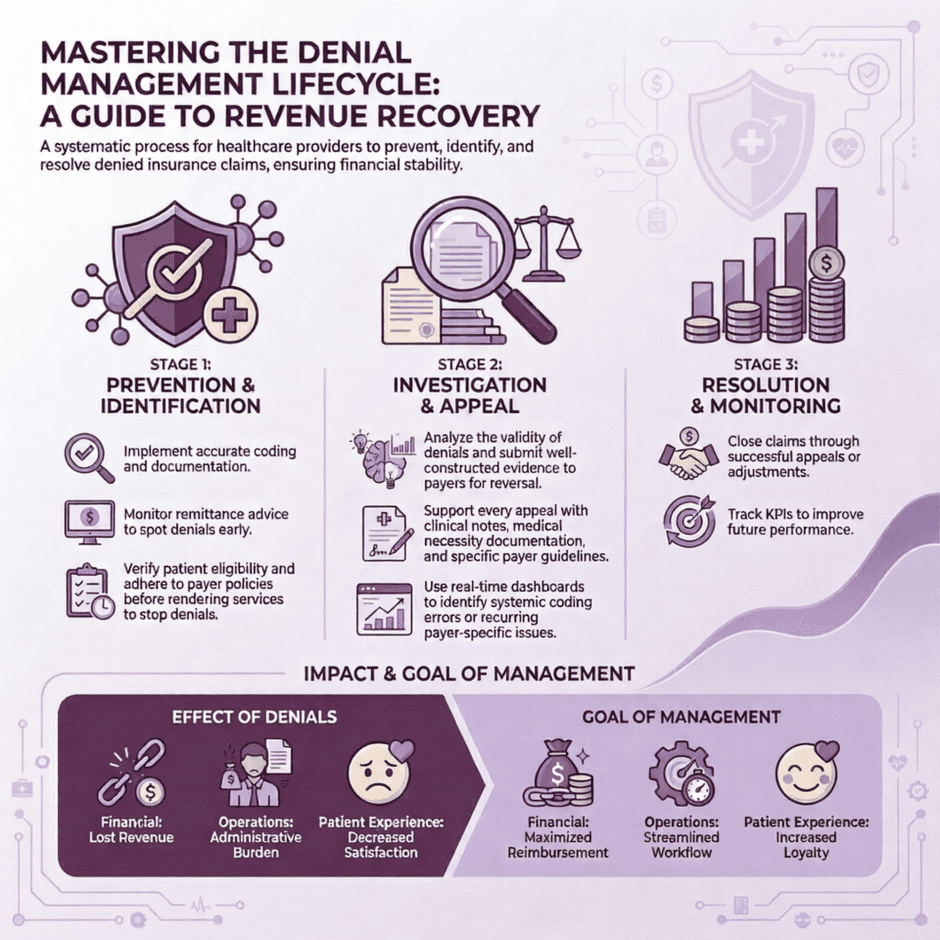
The denial management process typically involves several key steps, including:
- Prevention: Implementing measures to minimize the occurrence of denials through accurate coding, proper documentation, and adherence to payer policies.
- Identification: Promptly identifying denied claims and their root causes through regular monitoring and analysis of remittance advice and denial reports.
- Investigation: Thorough investigation of denied claims to determine the validity of the denial and gather supporting documentation or evidence for appeal.
- Appeal: Submitting well-constructed appeals to payers with relevant documentation and justifications for overturning the denial.
- Resolution: Resolving denied claims through appeals, adjustments, or write-offs, and putting corrective actions in place to prevent the same denials from recurring.
- Monitoring and Reporting: Continuously monitoring denial trends, tracking key performance indicators (KPIs), and generating reports to identify areas for improvement and measure the effectiveness of the denial management process.
Effective denial management requires a collaborative effort involving various stakeholders within the healthcare organization, including revenue cycle management teams, clinical staff, health information management professionals, and compliance officers.
Denial Prevention Strategies
Preventing denials from occurring in the first place is a crucial aspect of denial management, it cuts administrative burden, increases revenue capture, and improves operational efficiency. Implementing robust denial prevention strategies helps healthcare organizations minimize the occurrence of denied claims and streamline their revenue cycle processes.
- Accurate Coding and Documentation:
- Ensure accurate and compliant coding practices by providing thorough training and education to coding professionals.
- Implement regular coding audits and quality assurance measures to identify and address coding errors or inconsistencies.
- Promote clear and complete documentation practices among clinical staff, including detailed notes on medical necessity, services rendered, and patient histories.
- Utilize coding software and tools that automatically check for coding errors, missing information, or potential compliance issues.
- Payer Policy Adherence:
- Stay up-to-date with payer policies, guidelines, and coverage requirements for different services and procedures.
- Maintain a centralized repository of payer policies and ensure easy access for relevant staff members.
- Conduct regular payer policy reviews and provide training to staff on any changes or updates.
- Implement pre-authorization processes and obtain necessary approvals for services or procedures that require prior authorization.
- Patient Eligibility and Benefits Verification:
- Verify patient insurance eligibility and benefits prior to rendering services to ensure coverage and identify any potential issues or limitations.
- Maintain accurate and up-to-date patient demographic and insurance information.
- Provide financial counseling and education to patients regarding their coverage, deductibles, co-payments, and out-of-pocket expenses.
- Utilization Review and Medical Necessity Determination:
- Establish a thorough utilization review process to evaluate the medical necessity of services and procedures based on payer policies and guidelines.
- Involve clinical staff, such as physicians and case managers, in the utilization review process to ensure appropriate clinical justification.
- Document medical necessity and adherence to payer guidelines in patient records.
- Claims Scrubbing and Editing:
- Implement claims scrubbing and editing processes to identify and correct potential errors or missing information before submitting claims to payers.
- Utilize claims editing software or clearinghouse services to automatically check for coding accuracy, valid codes, and compliance with payer policies.
- Establish processes for resolving identified issues and resubmitting corrected claims promptly.
- Provider Credentialing and Enrollment:
- Ensure that all providers and facilities are properly credentialed and enrolled with payers to avoid denials related to provider or facility eligibility issues.
- Maintain up-to-date provider and facility information, including licenses, certifications, and accreditations.
- Monitor and renew credentials and enrollments as required to prevent lapses or expiration.
These denial prevention strategies cut down on denied claims and keep revenue cycle processes running smoothly.
Denial Identification and Root Cause Analysis
Prompt identification of denied claims and thorough root cause analysis are crucial steps in effective denial management. Recognizing denials quickly and tracing them to their root cause lets healthcare organizations take corrective action, cut revenue leakage, and strengthen their overall denial management processes.
- Monitoring and Analyzing Remittance Advice:
- Establish processes for regularly monitoring and analyzing remittance advice (RA) or explanation of benefits (EOB) received from payers.
- Identify denied claims, denial codes, and denial reasons from the RA/EOB data.
- Categorize denials based on factors such as denial reason, payer, service type, or provider, to facilitate analysis and reporting.
- Denial Reporting and Dashboards:
- Implement denial reporting and dashboard systems to provide real-time visibility into denied claims and their trends.
- Generate reports and dashboards that show key performance indicators (KPIs) related to denials, such as denial rates, denial reasons, and aging of denied claims.
- Use data visualization tools to identify patterns, outliers, and areas requiring immediate attention.
- Root Cause Analysis:
- Conduct thorough root cause analysis for denied claims to identify the underlying reasons and contributing factors.
- Involve relevant stakeholders, such as coding professionals, clinical staff, and revenue cycle managers, in the root cause analysis process.
- Review patient records, coding documentation, payer policies, and other relevant information to determine the root cause(s) of denials.
- Identify systemic issues, process gaps, or areas for improvement that may be contributing to recurring denials.
- Denial Tracking and Prioritization:
- Implement a denial tracking system to monitor the status and aging of denied claims throughout the appeals process.
- Prioritize denied claims based on factors such as potential financial impact, payer-specific guidelines, or regulatory requirements.
- Establish timelines and deadlines for addressing denied claims to ensure timely appeals and minimize the risk of write-offs or lost revenue.
- Trend Analysis and Reporting:
- Analyze denial trends over time to identify patterns, emerging issues, or areas requiring focused attention.
- Generate trend reports based on factors such as payer, service type, provider, or denial reason.
- Use trend analysis to identify opportunities for process improvements, staff training, or policy updates.
- Collaboration and Knowledge Sharing:
- Build collaboration and knowledge sharing among different departments and stakeholders involved in the denial management process.
- Conduct regular meetings or discussions to review denial trends, root causes, and best practices.
- Establish a centralized repository or knowledge base to document denial reasons, appeal strategies, and lessons learned for future reference.
Identifying denied claims quickly, tracing them to a root cause, and acting on the data gives healthcare organizations the insight to prioritize their efforts and fix what’s actually driving denials.
Appeals and Resolution Strategies
Once denied claims have been identified and their root causes analyzed, the next critical step in the denial management process is to formulate and execute effective appeals and resolution strategies. A well-structured appeal process, backed by strong documentation and justification, can significantly increase the chances of overturning denials and recovering lost revenue.
- Appeal Preparation and Documentation:
- Gather all relevant documentation and evidence to support the appeal, such as patient records, coding and billing information, payer policies, and clinical notes.
- Ensure that the documentation clearly demonstrates medical necessity, adherence to payer guidelines, and the appropriateness of the services rendered.
- Involve clinical staff, such as physicians and case managers, in providing supporting documentation and medical justification for the appeal.
- Appeal Letter and Submission:
- Craft a detailed appeal letter that clearly articulates the reasons for the appeal, addresses the specific denial reason(s), and provides supporting evidence and documentation.
- Use clear and concise language, and reference relevant payer policies, guidelines, or regulations to strengthen the appeal argument.
- Follow payer-specific guidelines and requirements for appeal submission, including deadlines, formats, and submission methods (e.g., online portals, fax, or mail).
- Maintain accurate records and tracking mechanisms for submitted appeals, including dates, supporting documentation, and communication with payers.
- Appeal Follow-up and Escalation:
- Establish processes for following up on submitted appeals and monitoring their status with payers.
- Set reminders or deadlines for follow-up communication to ensure timely resolution of appeals.
- Escalate appeals to higher levels within the payer organization or seek external assistance (e.g., third-party appeal services or legal counsel) if the first appeal doesn’t work.
- Negotiation and Compromise Strategies:
- In cases where outright appeal approval is challenging, explore negotiation and compromise strategies with payers.
- Consider partial payments, alternative coding or billing options, or other mutually agreeable resolutions.
- Maintain open communication and a collaborative approach with payers to find reasonable and fair resolutions.
- Write-off and Adjustment Processes:
- Establish clear criteria and processes for writing off or adjusting denied claims that can’t be appealed or resolved.
- Implement appropriate approvals and oversight for write-offs to ensure compliance and minimize financial losses.
- Analyze write-off trends and root causes to identify areas for process improvements or policy updates.
- Denial Management System and Automation:
- Implement a dedicated denial management system or software solution to streamline the appeals process, track submissions, and monitor outcomes.
- Use automation tools and workflows to reduce manual effort, improve efficiency, and ensure consistent and timely follow-up on appeals.
- Integrate the denial management system with other revenue cycle systems, such as billing and electronic health records (EHRs), for smooth data exchange and reporting.
- Staff Training and Continuous Improvement:
- Provide training to staff involved in the appeals process, including effective communication strategies, documentation requirements, and payer-specific guidelines.
- Encourage continuous learning and knowledge sharing among staff to stay current on payer policy changes, regulations, and best practices.
- Regularly review and analyze appeal outcomes to identify areas for improvement, develop targeted training programs, and refine appeal strategies.
A well-run appeals process recovers more denied revenue while keeping the relationship with payers intact.
Monitoring, Reporting, and Continuous Improvement
Effective denial management is an ongoing process that requires continuous monitoring, reporting, and improvement efforts. Regularly tracking key performance indicators (KPIs), analyzing denial trends, and acting on corrective steps helps healthcare organizations improve their denial management processes, revenue capture, and operational efficiency.
- Key Performance Indicators (KPIs) and Dashboards:
- Establish and monitor relevant KPIs related to denial management, such as denial rates, aging of denied claims, appeal success rates, and revenue recovery rates.
- Develop interactive dashboards and reporting tools that provide real-time visibility into KPIs and enable data-driven decision-making.
- Use data visualization techniques to identify patterns, outliers, and areas requiring attention or improvement.
- Denial Trend Analysis:
- Conduct regular analyses of denial trends to identify recurring issues, payer-specific challenges, or service lines with high denial rates.
- Analyze denial trends by factors such as payer, provider, service type, denial reason, or location, to pinpoint root causes and target improvement efforts.
- Use trend analysis to inform process improvements, staff training, policy updates, or contract negotiations with payers.
- Benchmarking and Best Practice Sharing:
- Participate in industry benchmarking initiatives or collaborate with peers to share best practices and insights related to denial management.
- Use industry data and benchmarks to assess the organization’s performance relative to industry standards and identify areas for improvement.
- Attend conferences, webinars, or networking events to stay updated on the latest trends, regulations, and emerging best practices in denial management.
- Process Improvement and Workflow Optimization:
- Based on data analysis, feedback, and lessons learned, continually review and optimize denial management processes and workflows.
- Identify bottlenecks, redundancies, or inefficiencies in the current processes and implement improvements through process reengineering or automation.
- Involve cross-functional teams and stakeholders in process improvement initiatives to ensure buy-in and effective implementation.
- Staff Training and Skill Development:
- Develop training programs and educational resources to build staff knowledge and skills related to denial management.
- Provide regular training sessions on coding and documentation best practices, payer policies and guidelines, appeal strategies, and denial prevention techniques.
- Encourage staff to pursue relevant certifications or continuing education opportunities to stay up-to-date with industry developments and best practices.
- Technology Evaluation and Adoption:
- Regularly assess new technologies, software solutions, or automation tools that can improve denial management processes and operational efficiency.
- Conduct cost-benefit analyses and risk assessments before adopting new technologies to ensure alignment with organizational goals and proper implementation.
- Provide training and support to staff during technology transitions to ensure smooth adoption and effective use of new tools or systems.
- Continuous Communication and Collaboration:
- Foster open communication and collaboration among various stakeholders involved in the denial management process, such as revenue cycle teams, clinical staff, compliance officers, and payer representatives.
- Establish regular meetings or forums to discuss denial trends, share best practices, and address challenges or concerns.
- Encourage cross-functional collaboration and knowledge sharing to build a culture of continuous improvement and learning within the organization.
Built into the denial management process, ongoing monitoring and reporting flag problems before they become patterns, so corrective action happens early instead of after revenue is already lost.
The Future of Denial Management
 Denial management is a crucial aspect of healthcare revenue cycle management, directly affecting an organization’s financial performance, operational efficiency, and ability to provide high-quality patient care. With changing regulations, payer policies, and technological advancements, healthcare organizations need a proactive, organization-wide approach to denial management.
Prevention, fast identification, strong appeals, and ongoing monitoring work together to cut revenue leakage and get more claims paid the first time. Building denial prevention strategies, catching and analyzing denied claims promptly, running an effective appeals process, and continuously monitoring results all reinforce each other.
Technology and data are central to modern denial management. Healthcare organizations should invest in denial management systems, reporting tools, and automation to streamline processes, gain visibility into denial trends, and support data-driven decisions. Regularly tracking KPIs and running trend analyses points to where the next round of process optimization and staff training should go.