

Genetic testing reimbursement often turns on a single claim line, and for many labs that line is CPT 81479, the unlisted molecular pathology code. Large tumor panels billed as 81455 or 81456 are among the highest-dollar claims in molecular billing, and both draw close payer review.
The coding itself is only the first gate. Medicare’s MolDX program and the lab benefit managers used by commercial plans each add requirements that a correct CPT code cannot satisfy alone. This guide is written for labs and practices that bill for genetic testing and need those claims to pay on the first submission.
Key Takeaways
- 81479 is for molecular tests that no Tier 1, Tier 2, genomic sequencing, MAAA or PLA code describes. It is billed as one unit per test with the test name and a DEX Z-Code.
- 81455 covers targeted panels of 51 or more genes using DNA or combined DNA and RNA analysis, and 81456 covers the same panels when only RNA is analyzed.
- MolDX states and UnitedHealthcare require a DEX Z-Code on molecular claims, and a missing or mismatched Z-Code is a common cause of denials.
- Stacking single-gene codes for a test that a panel code describes is unbundling, and payers deny or recoup it.
- Medical necessity for genetic tests rests on the ordering record, and above all on how the result will change the patient’s management.
How Molecular Codes Are Structured for Billing
Molecular pathology codes follow an order of preference, and choosing a code lower on that list when a better one exists is a frequent reason genetic testing claims are rejected.
The Order of Code Selection

Proprietary Laboratory Analyses (PLA) codes in the 0001U series come first, since CPT directs labs to report the PLA code when one exists for their specific test. Tier 1 codes from 81105 to 81383 describe analysis of a single named gene. Tier 2 codes 81400 to 81408 group less common genes by technical complexity. Genomic sequencing procedures from 81410 to 81471 cover multi-gene panels, exomes and genomes, and MAAA codes from 81490 to 81599 cover algorithmic assays. The unlisted codes 81479 and 81599 apply only when nothing above them fits.
Where to Look Up Individual Codes
This guide focuses on the reimbursement side of the highest-value codes. Our reference on CPT codes used in genetic testing billing covers the full code families, including hereditary cancer and carrier screening panels.
Billing CPT 81479 for Unlisted Molecular Tests
Unlisted codes have no fixed fee, so every 81479 claim is priced and reviewed on its own documentation.
When 81479 Is the Right Code
Use 81479 for a molecular pathology test that no specific CPT or PLA code describes, such as a new laboratory-developed test or a gene without its own Tier 1 or Tier 2 code. It should not stand in for a test that has a code the lab finds inconvenient. Payers including UnitedHealthcare state in their policies that unlisted codes should be reported only when no other code adequately describes the service.
How to Report It on the Claim
Report one unit of 81479 per test, regardless of the number of genes or variants analyzed. Enter the test name or a short description with the DEX Z-Code in the narrative field, which is loop 2400 or SV101-7 on an 837P and box 19 on a paper claim. Facility claims carry the identifier in SV202-7 or form locator 80. Multiple units of 81479 for one test on one date of service are usually treated as an error.
Pricing and Coverage
Medicare contractors price unlisted molecular tests individually, often by crosswalk to a comparable coded test. In MolDX states, coverage for a laboratory-developed test usually depends on a completed technical assessment that reviews analytical and clinical validity. UnitedHealthcare’s Medicare Advantage policy for unlisted molecular codes shows how a payer lists the specific tests it will and will not cover under 81479 and 81599.
81599 for Unlisted Algorithmic Assays
81599 is the unlisted code for multianalyte assays with algorithmic analyses. It follows the same rules as 81479, with one unit per test and the test name and Z-Code on the claim. Use it when the test combines multiple analytes into a proprietary score and no MAAA or PLA code exists for it.
Coding Large Panels With 81455 and 81456
Comprehensive tumor profiling panels are among the most expensive tests a lab bills, and the analyte type decides the code.
DNA Versus RNA Analysis
81455 describes a targeted genomic sequence analysis panel of 51 or more genes for a solid organ or hematolymphoid neoplasm or disorder, using DNA analysis or combined DNA and RNA analysis. 81456 describes the same panel when only RNA is analyzed, interrogating sequence variants, copy number variants or rearrangements, or expression levels. A test that analyzes both DNA and RNA is reported with 81455, not with both codes.
Smaller Panels
Panels of 5 to 50 genes use the smaller codes in the same family. For hematolymphoid disorders, 81450 covers DNA or combined DNA and RNA analysis, with separate codes for RNA-only and solid organ panels. Count the genes actually reported on the final report, since a panel that drops below 51 genes for a given specimen changes the code.
Medicare Coverage for Tumor Sequencing
National Coverage Determination 90.2 covers next generation sequencing for patients with recurrent, relapsed, refractory, metastatic or advanced stage III or IV cancer who plan further treatment. Tests with FDA approval or clearance as a companion diagnostic are covered nationally. Other NGS tests are left to the local contractor, which in MolDX states means the technical assessment process. NCD 90.2 also covers germline testing for patients with ovarian or breast cancer and a clinical indication for hereditary cancer risk.
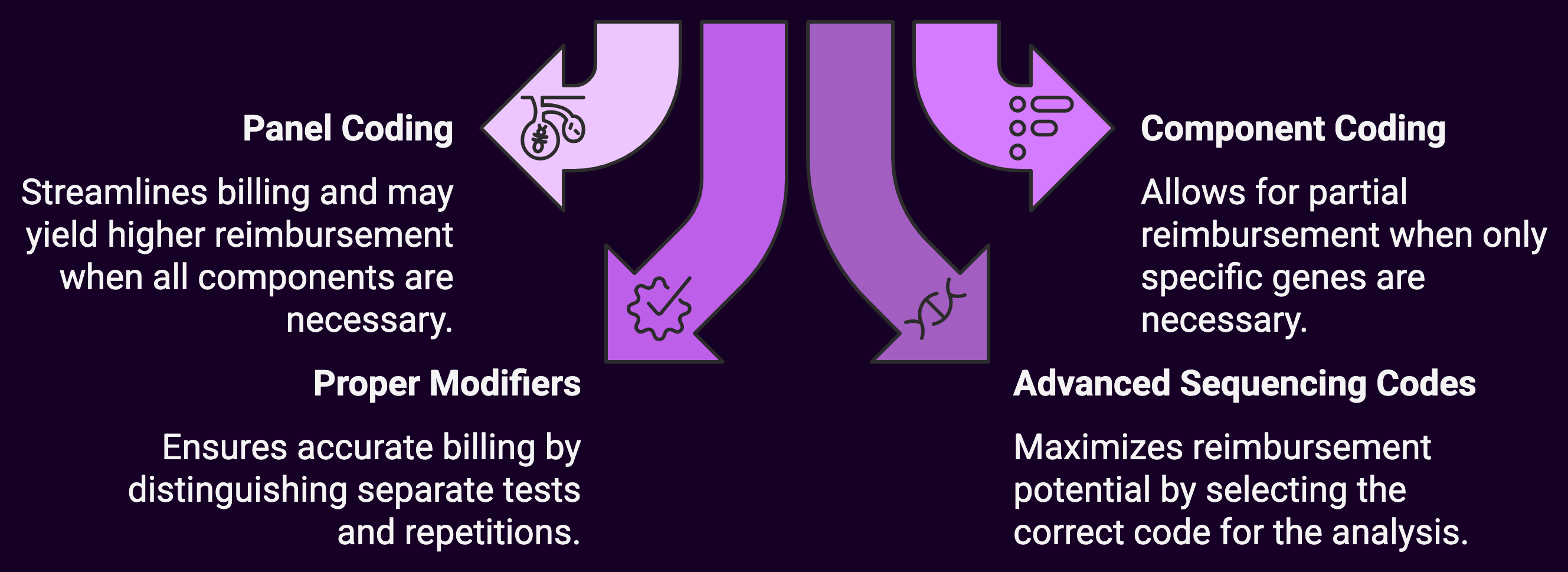
Panel Coding Versus Single-Gene Coding
Choosing between one panel code and several single-gene codes is a compliance decision as much as a revenue one.
Bill the Test as Performed
When a genomic sequencing procedure code describes the test, report that code. Billing a list of Tier 1 and Tier 2 codes for genes analyzed in a single panel is unbundling, and NCCI edits and payer policies are written to catch it. UnitedHealthcare, for example, denies multiple molecular CPT codes billed with the same Z-Code for the same patient and date of service.
When Single-Gene Codes Are Correct
Single-gene codes are correct when the ordering clinician requested specific genes and the lab analyzed only those genes. Reflex testing that adds a separate gene after an initial result can also support a separate code, as long as the order and the result report show two distinct tests. Our guide to common genetic testing modifiers covers modifier 59, XS and 91 for those situations.
Pharmacogenomic Panels
Pharmacogenomic testing raises the same panel question, since many PGx panels report several genes that each have a Tier 1 code. Coverage is narrower than for oncology, and MolDX limits PGx testing to genes with a documented drug-gene interaction relevant to the patient’s current or planned medication. Our breakdown of pharmacogenetic testing CPT codes lists the individual gene codes.
DEX Z-Codes and Test Registration
A correct CPT code without a valid Z-Code will not pay in much of the country.
What a Z-Code Does
A DEX Z-Code is a test-specific identifier issued through the Palmetto GBA DEX registry. It tells the payer exactly which test was run, since a single CPT code such as 81479 can describe hundreds of different tests. The MolDX program, which governs molecular testing across most Medicare contractor jurisdictions, has used Z-Codes since 2013. ASCP’s overview of the expanding role of Z-Codes explains how UnitedHealthcare extended the requirement to its commercial claims.
Registering and Sharing Codes
The performing lab registers each in-house test and receives its Z-Code. A lab that refers tests to another lab requests sharing in DEX so it can bill with the performing lab’s code. A test run with the same method at several locations needs one registration, while a different method at another site needs its own.
Keeping the Registry Accurate
Z-Codes are tied to a specific test design. When a lab adds genes, changes platforms or alters the method, the registration may need updating before claims for the revised test are submitted. A Z-Code that no longer matches the test performed is a common source of denials on high-dollar claims.
Medical Necessity Documentation for Genetic Tests
Payers review genetic test claims against written coverage criteria, and the ordering record has to meet them before the specimen arrives.
What the Order Should Show
The record should include the diagnosis or clinical suspicion and relevant personal and family history. Add any prior genetic results and a statement of how the result will change treatment, surveillance or family testing. Tests ordered for screening or general risk without symptoms or a qualifying history are generally excluded by Medicare.
Genetic Counseling
Many commercial policies require pre-test genetic counseling for hereditary cancer and other germline tests. Record who provided the counseling and their credentials. The note should also show that the limits of the test were discussed.
Prior Authorization
Commercial plans often send genetic testing prior authorization through lab benefit managers that apply their own clinical criteria. Submit the request with the counseling note and family history attached, because incomplete requests are a frequent reason for a pend or denial at that stage. Our article on managing genetic testing coverage walks through coverage review in more detail.
Medicare Billing Rules That Affect Lab Payment
Beyond coverage, several Medicare billing rules decide who bills the test and what Medicare pays.
The Date of Service Exception
For molecular pathology tests and advanced diagnostic laboratory tests on specimens collected during a hospital outpatient encounter, the date of service can be the date the test was performed instead of the collection date. When the test is performed after discharge, results did not guide treatment during the encounter and the other conditions are met, the performing lab bills Medicare directly rather than the hospital. Noridian’s summary of the date of service exception lists every condition.
Advance Beneficiary Notices
Genetic tests that are statutorily excluded, such as screening without symptoms, are billed with modifier GY and do not require an ABN. Tests that may be denied as not reasonable and necessary need a valid ABN before the specimen is collected, with modifier GA on the claim. An ABN signed after collection does not shift liability to the patient.
Fee Schedule Pressure
Most molecular tests are paid under the Clinical Laboratory Fee Schedule, which faces possible cuts of up to 15 percent per test per year from 2027 under PAMA unless Congress acts. Tests designated as ADLTs follow a separate rate-setting process based on the lab’s own private payer data.
Denials, Appeals and Patient Balances
High-dollar genetic claims justify more appeal work than most lab claims, and patient balances need a plan before the test is run.
Reading Molecular Denials
Separate denials by cause before appealing. A missing Z-Code or unit error is corrected and resubmitted, while a medical necessity denial needs records and clinical support. Track denials by test and payer so a recurring problem gets fixed at the source.
Building the Appeal
Medical necessity appeals for genetic tests succeed when they connect the patient’s history to the payer’s own policy criteria and cite the clinical guidelines behind the order. Include the result report and a letter from the ordering clinician explaining how the result changed care. Our guide to writing a medical claim appeal letter covers the structure.
Patient Financial Responsibility
Genetic tests often land on deductibles or coinsurance, and an unexpected bill can lead to complaints and unpaid balances. Give patients an estimate before testing and offer payment options, especially for tests that are likely to fall under a high-deductible plan. Our article on patient financial responsibility covers collection practices that work.
Genetic Testing Billing FAQ
When should CPT 81479 be used?
CPT 81479 is used for a molecular pathology test that no Tier 1, Tier 2, genomic sequencing procedure, MAAA or PLA code describes. It is billed as one unit per test, with the test name and DEX Z-Code in the claim narrative.
What is the difference between CPT 81455 and 81456?
Both cover targeted genomic sequence analysis panels of 51 or more genes for a solid organ or hematolymphoid neoplasm or disorder. 81455 is used for DNA analysis or combined DNA and RNA analysis, and 81456 is used when only RNA is analyzed.
Can 81455 and 81456 be billed together?
Not for a single combined test. A panel that analyzes both DNA and RNA is reported with 81455 alone.
What is a DEX Z-Code?
A DEX Z-Code is a test-specific identifier issued by the Palmetto GBA DEX registry. MolDX Medicare contractors and UnitedHealthcare require it on molecular claims so the payer knows which test was performed.
Is it acceptable to bill individual gene codes instead of a panel code?
Only when the lab tested just the genes that were ordered. When a genomic sequencing procedure code describes the test performed, billing separate single-gene codes is unbundling and will be denied or recouped.
What is CPT 81599 used for?
CPT 81599 is the unlisted code for multianalyte assays with algorithmic analyses. It is used when a test combines several analytes into a proprietary result and no specific MAAA or PLA code exists.
Does Medicare cover next generation sequencing for cancer?
Under NCD 90.2, Medicare covers NGS for patients with recurrent, relapsed, refractory, metastatic or advanced stage III or IV cancer who are seeking further treatment. FDA-approved companion diagnostics are covered nationally, and other NGS tests are covered at the local contractor’s discretion.
Medwave’s Approach to Molecular Lab Revenue
 A single denied 81455 claim can outweigh a week of routine lab billing. That math is why molecular labs need claim edits that check the Z-Code, the unit count and the payer’s coverage policy before anything is submitted.
Medwave has supported 15,000+ providers, and our claims go out at a 98% clean claim rate. For genetic testing labs we maintain the Z-Code and CPT crosswalk that drives those edits. When a molecular claim is still denied, our team takes it through appeal. Payer enrollment for a new lab location averages 85 days with our credentialing team. To talk through your molecular claims, use the form below.
Disclaimer: This article is provided for informational purposes only and does not constitute legal, billing or financial advice. CPT codes, coverage determinations and payer policies change, and providers should verify current requirements with each payer and Medicare contractor before applying any coding approach. CPT® is a registered trademark of the American Medical Association.

Co-Founder and COO of Medwave, bringing more than 25 years of hands-on experience in healthcare revenue cycle management, payer contracting, and medical credentialing.