
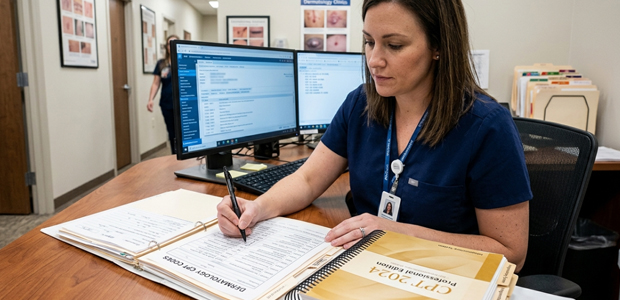
Dermatology billing uses a distinct set of CPT codes grouped by procedure type. Those are evaluation and management visits, biopsies, shave removals, excisions, destruction of lesions, Mohs surgery, and phototherapy. The correct code depends not just on what procedure was performed, but on the size, location, and complexity of the lesion, and on whether the work was separate from another procedure billed the same day.
Coding errors in dermatology are common and expensive. Undercoding office visits, missing modifier 25 when a procedure and an E/M visit occur on the same day, or using the wrong excision code because the measurement was taken before rather than after excision are all mistakes that result in underpayment or denial. Prior authorization requirements for biologics and phototherapy add another layer of denial risk that requires separate documentation.
This guide covers the CPT codes used most often in dermatology billing, the documentation requirements for each major procedure category, and the most frequent coding errors that cause denials in dermatology practices.
What are Dermatology CPT Codes?
 CPT codes, or Current Procedural Terminology codes, are standardized numerical identifiers developed by the American Medical Association. These codes describe medical procedures and services so that healthcare providers, insurance companies, and Medicare can communicate clearly about what services were performed.
In dermatology, CPT codes identify skin procedures ranging from routine office visits and biopsies to complex surgical excisions and cosmetic treatments. Dermatology CPT codes are distributed across several sections, including Evaluation & Management (99202–99215), Integumentary System surgery codes (10000s–19999), and Pathology & Laboratory codes, depending on the type of service provided. Each code represents a specific procedure, the body site being treated, and the complexity of the service performed during the patient’s visit.
Think of these codes as the universal language between your practice and the payers. When you submit a claim with the correct dermatology CPT code, the insurance company knows exactly what service you provided, why it was medically necessary, and how much you should be reimbursed.
How are Dermatology CPT Codes Organized?
Dermatology codes break down into several main categories, each covering different types of services.
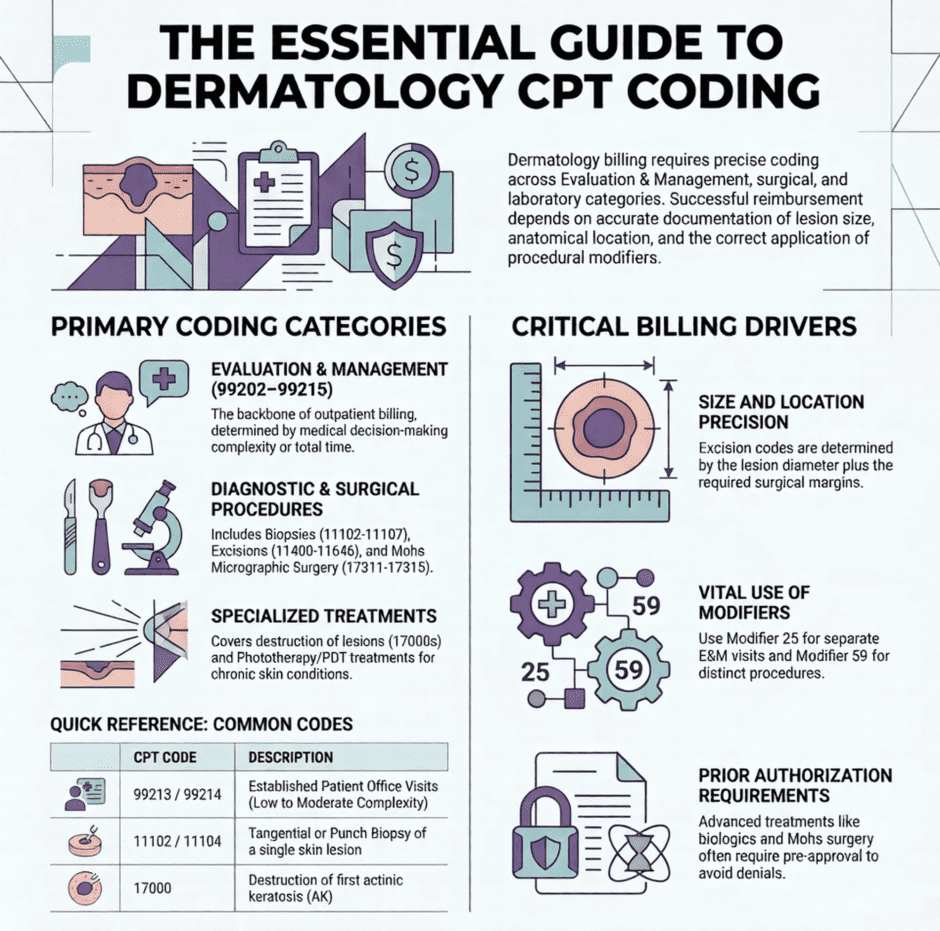
Here’s how the major categories are structured:
- Evaluation & Management / Office Visits (99202–99215): These codes cover new and established patient visits. The level of service is determined by medical decision-making complexity or total time spent, and they form the backbone of most outpatient dermatology practices.
- Biopsies (11102–11107): These codes apply to skin tissue sampling for diagnostic purposes. The correct code depends on the biopsy technique used, tangential (shave), punch, or incisional, as well as whether it is the first or an additional lesion.
- Destruction of Benign or Premalignant Lesions (17000–17286): When lesions such as actinic keratoses, warts, or molluscum are destroyed via cryotherapy, laser, or chemical means, these codes apply. Code selection depends on the method used and the number of lesions treated.
- Excisions (11400–11646): These codes cover surgical removal of benign and malignant skin lesions. Code selection depends on lesion size including margins, the anatomical location, and whether the lesion is benign or malignant.
- Mohs Micrographic Surgery (17311–17315): Mohs surgery has its own dedicated code range for the excision and real-time histologic evaluation of skin cancers. Codes are selected based on the anatomical location and the number of stages required.
- Repairs and Wound Closures (12001–16036): These codes cover simple, intermediate, and complex wound repairs. Selection depends on the repair type, the anatomical site, and the total length of the closure in centimeters.
- Phototherapy and Photodynamic Therapy (96900–96913, 96567–96571): Treatments using ultraviolet light or photosensitizing agents fall under these codes, commonly used for psoriasis, eczema, acne, and actinic keratoses.
What are the Most Common Dermatology CPT Codes?
While there are hundreds of dermatology codes, certain procedures occur far more frequently than others. Knowing these common codes helps streamline your billing process and reduce errors.
CPT 99213 / 99214
These established patient office visit codes are the most frequently billed codes in dermatology. 99213 is used for low-complexity visits, while 99214 covers moderate-complexity encounters such as evaluating a suspicious lesion, managing chronic skin conditions, or initiating a new systemic treatment. Selecting the correct level requires documentation of medical decision-making or total time.
CPT 11102
11102 covers a tangential (shave) biopsy of a single skin lesion. This is one of the most commonly performed diagnostic procedures in dermatology and is typically used to sample superficial lesions such as seborrheic keratoses, basal cell carcinomas, or dysplastic nevi. Use add-on code 11103 for each additional lesion.
CPT 11104
11104 covers a punch biopsy of a single skin lesion and is frequently used when a full-thickness skin sample is needed to evaluate inflammatory dermatoses, deeper tumors, or uncertain diagnoses. Add-on code 11105 applies to each additional punch biopsy performed during the same session.
CPT 17000 / 17003
17000 covers the destruction of the first actinic keratosis (AK), while 17003 is the add-on code used for lesions two through fourteen. Since actinic keratoses are among the most common conditions treated in dermatology, these codes appear regularly on claims. Documentation must specify the number of lesions treated and the destruction method used.
CPT 11441 / 11442 / 11443
These codes cover excision of benign lesions on the face, ears, eyelids, nose, lips, and mucous membranes. Code selection depends on the excised diameter including margins: 11441 for lesions 0.6–1.0 cm, 11442 for 1.1–2.0 cm, and 11443 for 2.1–3.0 cm. Accurate measurement documentation is critical to prevent downcoding or denials.
CPT 11600–11606
These codes cover excision of malignant lesions of the trunk, arms, and legs. Selection follows the same size-based structure as benign excisions but carries higher reimbursement rates reflecting the additional complexity and margin planning required. Paired ICD-10 diagnosis codes identifying the specific malignancy are essential.
CPT 17311
17311 covers Mohs micrographic surgery of the head, neck, hands, feet, genitalia, or any location with surgery involving one stage. This is a high-value code used for the treatment of complex or high-risk skin cancers. Additional stage codes (17312) are appended for each subsequent surgical stage performed during the same session.
CPT 96910 / 96912 / 96913
These codes cover phototherapy services, 96910 for ultraviolet B (UVB), 96912 for psoralen plus UVA (PUVA), and 96913 for phototherapy to the face, body, hands, and feet. These codes are frequently used to treat psoriasis, vitiligo, atopic dermatitis, and other photoresponsive conditions.
CPT 96567 / 96570 / 96571
These codes apply to photodynamic therapy (PDT). 96567 covers PDT by external application of a photosensitizer, while 96570 and 96571 apply to PDT using endoscopic guidance. For most dermatology practices treating actinic keratoses or acne with aminolevulinic acid (ALA), 96567 is the relevant code.
CPT 10060 / 10061
10060 covers simple incision and drainage of a single abscess, cyst, or furuncle, while 10061 applies to complicated or multiple abscesses. These codes are commonly used in dermatology for cyst rupture, pilonidal cysts, and skin infections requiring drainage.
How Do Lesion Size and Location Affect Code Selection?
 Unlike radiology, where the type of equipment and anatomical region primarily drive code selection, dermatology billing is heavily influenced by two variables: lesion size and anatomical location.
For excision codes, the measured diameter of the lesion plus the required surgical margins determines the correct code. A 0.5 cm lesion with 0.3 cm margins on each side bills as a 1.1 cm excision. If you document only the lesion diameter without recording the margins, your claim may be denied or down-coded by the payer.
Anatomical location creates separate code families for the same type of procedure. Face, ears, eyelids, nose, lips, and mucous membranes carry different codes than the trunk, arms, or legs, and different reimbursement rates. Dermatologists must document the exact anatomical site for every procedure to ensure accurate code selection.
When multiple lesions are excised during the same session, each is billed separately with its own CPT code. This is different from destruction codes, where add-on codes capture the additional lesions at a reduced rate.
Which Modifiers are Essential in Dermatology Billing?
Dermatology billing uses several modifiers that provide important details about the service performed:
- Modifier 25 (Significant, Separately Identifiable E&M on the Same Day as a Procedure): This is one of the most commonly used modifiers in dermatology. When a patient presents for a procedure but the physician also performs a medically necessary evaluation and management service on the same day, modifier 25 is appended to the E&M code. Documentation must clearly support that the E&M was distinct from the pre- and post-service work of the procedure.
- Modifier 59 (Distinct Procedural Service): When two procedures that are typically bundled are performed separately and independently, modifier 59 clarifies that the services were distinct. Use this carefully and only when your documentation clearly supports the separation.
- Modifier 51 (Multiple Procedures): When more than one surgical procedure is performed during the same operative session, modifier 51 is appended to the secondary procedure codes to indicate reduced payment is appropriate. Some procedures are exempt from modifier 51, always verify.
- Modifier RT (Right Side) and LT (Left Side): These anatomical modifiers specify which side of the body was treated, particularly important for bilateral lesion excisions or procedures on paired anatomical sites.
- Modifier 58 (Staged or Related Procedure): When a follow-up procedure during the post-operative period was planned as part of a staged treatment, common in Mohs surgery or complex wound closures, modifier 58 documents that the subsequent service was anticipated.
- Modifier 79 (Unrelated Procedure During Postoperative Period): If a patient returns during a global surgery period for a completely unrelated procedure, modifier 79 prevents the claim from being bundled into the original surgery payment.
- Modifier 57 (Decision for Surgery): When an evaluation and management service on the day of or the day before a major surgical procedure leads to the decision to perform that surgery, modifier 57 is appended to the E&M code to ensure it is reimbursed separately.
When using multiple modifiers on a single code, the order matters, list modifiers that affect payment first. The key is always ensuring your documentation supports every modifier you append to the claim.
What Documentation Do You Need for Dermatology Claims?
 Proper documentation makes or breaks dermatology claims. Insurance companies require specific elements before they will process your claim and issue payment.
Every dermatology claim needs a diagnosis code explaining why the procedure was medically necessary. ICD-10 codes describe the patient’s condition, a specific diagnosis like basal cell carcinoma of the scalp (C44.41) is far stronger than a non-specific code. Vague or unspecified diagnosis codes frequently trigger denials, so be as precise as possible.
For excision claims, your documentation must include the exact size of the lesion and the margins planned or achieved. If the pathology report describes a larger lesion than what was documented in the operative note, expect scrutiny. The clinical measurement prior to excision and the pathology specimen size should be consistent.
For destruction of multiple actinic keratoses, your records must document the number of lesions treated and the method used. If you bill 17000 plus several units of 17003 but your note mentions only “multiple AKs treated,” payers may request additional documentation or deny the claim.
For Mohs surgery, each stage requires documentation of the tissue map, the number of blocks examined, and the pathology findings before proceeding to the next stage. This is both a medical and billing requirement, and incomplete Mohs documentation is one of the leading causes of audits in dermatology.
The physician’s order, the clinical history, and a clear description of the procedure performed, including the anatomical site, technique, and closure method, should all appear in every procedure note. Completeness and accuracy are critical.
What Common Billing Errors Should You Avoid?
Even experienced billing staff make mistakes with dermatology codes. Being aware of common pitfalls helps you avoid costly billing errors.
- Upcoding occurs when you bill for a larger excision size or a higher complexity service than was actually provided. For example, billing an 11443 excision (2.1–3.0 cm) when only a 1.5 cm lesion with margins was removed inflates reimbursement inappropriately and can trigger audits and penalties.
- Undercoding is the opposite problem. If your documentation supports a 99214 but you consistently bill 99213 out of habit, you lose revenue you legitimately earned and undervalue the complexity of your care.
- Missing Modifier 25 is one of the most common and costly dermatology billing errors. When a significant E&M service is performed on the same day as a procedure, failing to append modifier 25 to the office visit code will result in the E&M being denied as bundled into the procedure.
- Bundling errors occur when procedures that should be billed separately are incorrectly combined into one code, or when separately billable services are inadvertently submitted as a single bundled service. Reviewing NCCI edits regularly helps prevent this.
- Incomplete lesion documentation leads to denials even when the correct code is used. If you bill for a 2.1 cm excision but your operative note records only a 0.8 cm lesion with no mention of margins, expect the claim to come back unpaid or down-coded.
- Cosmetic vs. medical coding confusion is a significant dermatology-specific risk. Many procedures, such as removing a benign skin tag, may not be covered when performed for cosmetic reasons. When a procedure is performed for a documented medical indication, your ICD-10 code must clearly reflect that. Failing to do so results in cosmetic non-covered denials that are difficult to appeal.
How Do New Technology and AI Impact Dermatology Billing?
 The dermatology field continues advancing rapidly, and these changes affect billing practices. Electronic health record systems now often include built-in coding assistance to help prevent common errors. These systems can suggest appropriate codes based on procedure descriptions and clinical documentation.
Computer-aided coding tools analyze procedure notes and recommend appropriate codes, making the billing process more efficient. However, human oversight remains essential, technology can suggest codes, but experienced coders must verify that the suggestions match the actual service performed and the documentation provided.
Artificial intelligence is also beginning to play a role in dermatology billing. Some systems can analyze clinical notes and automatically recommend CPT codes based on the procedure described and the lesion characteristics documented. While this shows real promise for reducing coding errors and speeding up the billing process, it is not yet sophisticated enough to replace human judgment, particularly for nuanced decisions like distinguishing a medical from a cosmetic indication.
The American Medical Association updates CPT codes annually. The dermatology section sees periodic revisions, with biopsy codes having been significantly restructured in recent years. Staying current with these changes is critical because using outdated codes leads to claim denials.
What Role Does Prior Authorization Play?
Many insurance companies now require prior authorization for certain dermatology procedures, particularly advanced treatments such as biologic therapies, photodynamic therapy, phototherapy, and Mohs surgery on certain anatomical sites. This means you must obtain approval from the payer before performing the procedure, or risk not getting paid.
Prior authorization requirements vary widely by payer and plan. Some payers require authorization for all biologic prescriptions like dupilumab or secukinumab, while others only require it when step therapy criteria have not been documented. For procedures, requirements differ by anatomical location, lesion diagnosis, and clinical history.
Failing to obtain required prior authorization is one of the fastest ways to get a claim denied. The procedure may have been medically necessary and properly performed, but without that prior approval, many payers will refuse payment. Your practice then faces the difficult position of either writing off the charge or attempting to collect from the patient, which can damage patient relationships.
Building prior authorization checks into your scheduling process helps avoid these problems. Before scheduling high-cost procedures or initiating biologic therapies, verify whether authorization is needed and obtain it if required. Track authorization numbers and include them on claims to smooth the payment process.
Dermatology Billing FAQ
What CPT codes are most common in dermatology billing?
Dermatology billing relies on evaluation and management codes (99202-99215), biopsy codes (11102-11107), destruction codes for benign or premalignant lesions (17000-17286), excision codes (11400-11646), and codes for Mohs surgery and phototherapy. Each group has its own rules for lesion size, location, and technique that determine which specific code applies.
How do biopsy CPT codes differ from excision codes?
Biopsy codes (11102-11107) apply to tissue sampling taken for diagnostic purposes and depend on whether the technique was tangential, punch, or incisional, plus whether additional lesions were sampled. Excision codes (11400-11646) apply to full surgical removal of a lesion and are selected based on the size of the lesion plus margins, its location on the body, and whether it is benign or malignant.
Why does lesion measurement timing cause coding errors?
Excision codes are based on the size of the lesion plus its margins after removal, not before. When staff record the measurement taken prior to excision, the wrong code often gets selected, which leads to underpayment or claim denial. Accurate documentation of the post-excision measurement is needed to choose the correct code.
What is modifier 25 and why does it matter in dermatology billing?
Modifier 25 indicates that a separately identifiable evaluation and management visit occurred on the same day as a procedure. Missing this modifier when both services took place is a frequent billing mistake in dermatology practices and often results in denied or reduced payment for the office visit.
Why do biologics and phototherapy face extra denial risk?
Biologics and phototherapy typically require prior authorization from the payer before treatment is covered. This adds a separate documentation step beyond standard coding, and missing or incomplete authorization records are a common cause of claim denials for these treatments.
How are dermatology CPT codes structured within the CPT code set?
Dermatology services draw from several CPT sections: Evaluation and Management codes numbered 99202 through 99215, Integumentary System surgery codes in the 10000 to 19999 range, and relevant Pathology and Laboratory codes. Each code specifies the procedure, the body site treated, and the level of service performed during the visit.
How Can You Improve Your Dermatology Billing Operations?
 Given the intricacies of dermatology coding and billing, from lesion measurement requirements to modifier 25 rules and cosmetic exclusions, many practices struggle to keep up with claim submissions, denials, and follow-up. Errors in coding or documentation lead to denied claims, delayed payments, and lost revenue. Even small mistakes add up when you’re dealing with dozens of procedures per day.
Staying current with annual CPT code updates, payer-specific requirements, and changing regulations requires significant time and expertise. Your clinical staff is focused on providing excellent patient care. Adding billing responsibilities to their workload often leads to mistakes and burnout.
This is where specialized support makes a real difference. At Medwave, we handle medical billing, credentialing, and payer contracting for healthcare providers, including dermatology practices. Our team stays current with the latest coding updates, modifier requirements, and payer policies so you don’t have to. We handle everything from initial claim submission through denial management and appeals, working to maximize your reimbursement while reducing your administrative burden.
Whether you need help with your entire revenue cycle or just want support with specific aspects like coding or credentialing, partnering with experts who specialize in dermatology billing can improve your cash flow, reduce claim denials, and free up your staff to focus on patient care.

Co-Founder and COO of Medwave, bringing more than 25 years of hands-on experience in healthcare revenue cycle management, payer contracting, and medical credentialing.