

Healthcare organizations often don’t receive the full reimbursement they’ve earned, even when both parties have agreed on rates. The culprits are predictable: hidden policy modifications, post-authorization claim denials, and contract gaps that leave new or unlisted services underpaid. According to the American Medical Association, more than 15% of commercial insurance claims are initially denied, with many resulting from contract language failures that could have been prevented at negotiation.
Most practices lack dedicated payer contracting specialists who regularly audit agreements and track policy changes. This leaves them exposed to revenue disruptions that compound quietly over time. Three specific contract phrases address the most frequent sources of these losses, and should be non-negotiable elements of every payer agreement.
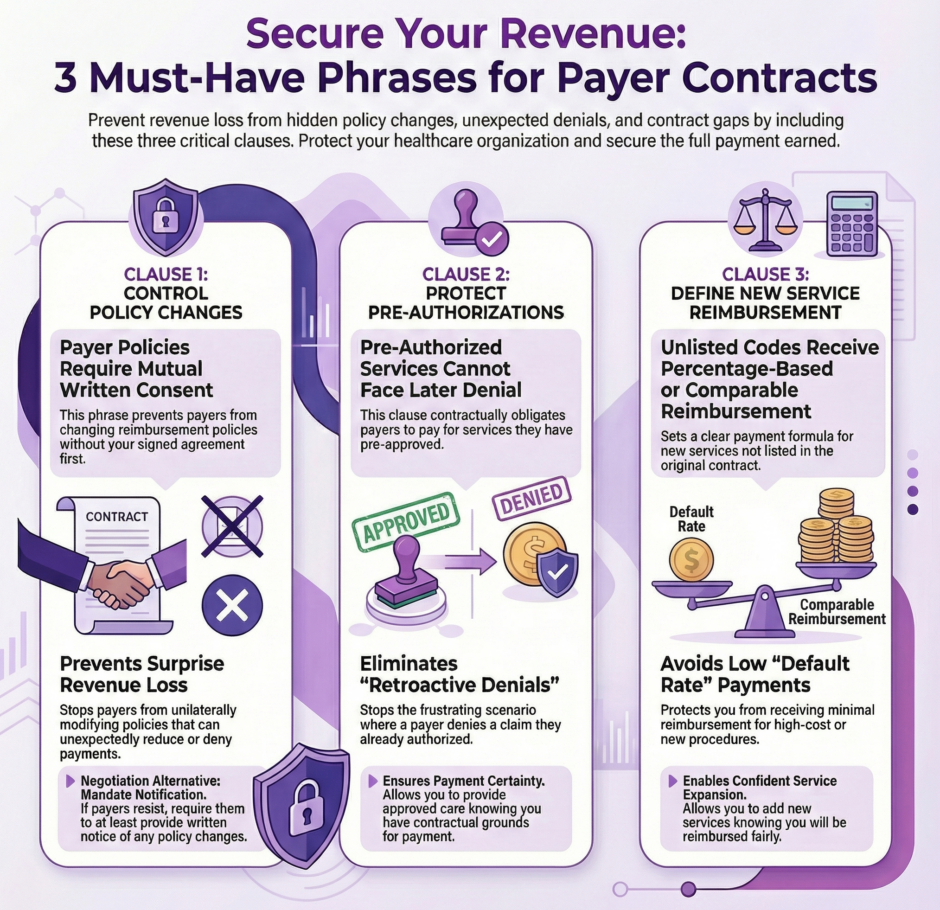
The 3 phrases that protect healthcare providers in payer contract negotiations:
- Mutual Written Consent: “Provider is not obligated to follow payer policies without written agreement from both parties.” Prevents unauthorized policy changes.
- Prior Authorization Lock: “After approval of service authorization, denial cannot occur either initially or later.” Prevents post-auth claim denials.
- Unlisted Code Coverage: “Codes not included in this agreement will receive reimbursement at a percentage of charges or at rates matching similar existing services.” Ensures fair payment for new services.
Why Do Payer Contracts Require Protective Contract Language?

After delivering care, healthcare organizations submit claims and await payment. Payers approve or deny each one based on their internal policies, and those policies can change without your knowledge. Payer contracts establish the rules governing payment amounts, timing, policy modification procedures, and dozens of operational details that directly affect your revenue.
The challenge is volume. Most organizations manage contracts with dozens of payers simultaneously, juggling renewals, renegotiations, and new agreements throughout the year. Without systematic review and protective language in place, a single policy change buried in a payer’s online portal can silently trigger hundreds of claim denials before anyone notices. The three phrases below close the most common contractual gaps.
How Can Providers Stop Payers from Changing Policies Without Notice?
Phrase 1 — Mutual Written Consent for Policy Changes
“Provider is not obligated to follow payer policies without written agreement from both parties.”
Payers may update clinical policies, billing requirements, or covered procedure lists without directly notifying in-network providers. When those updates take effect, claims submitted under outdated guidelines are denied, and the provider had no opportunity to adapt.
This clause creates a contractual requirement that any policy change affecting your organization must receive your written agreement before it takes effect. If a payer wants to add step-therapy requirements, change coding standards, or alter prior authorization triggers, they must engage you in the process. You can assess the revenue impact, negotiate modifications, and update operations in advance rather than discovering the change when claims start bouncing.
If a payer won’t accept mutual written consent, negotiate at minimum for written notification with a 30–60 day implementation window before changes apply to submitted claims. Even an email notification gives your team time to retrain staff, update billing procedures, and avoid surprise denials. The goal is eliminating the information gap, payer policies directly affect documentation requirements, prior authorization workflows, and claim submissions, so knowing about changes before they’re enforced is a basic operational necessity.
Can a Payer Deny a Claim After Giving Prior Authorization?
Phrase 2 — Prior Authorization as a Payment Guarantee
“After approval of service authorization, denial cannot occur either initially or later.”

Prior authorization exists to confirm coverage before a service is provided. Once a payer issues an authorization number and approves a procedure, the logical expectation is payment. In practice, payers sometimes deny claims even after issuing authorization, citing policy changes, medical necessity reconsiderations, or documentation requirements that weren’t mentioned during the authorization process.
Consider this common scenario. A cardiologist recommends bypass surgery. The organization calls the payer, receives authorization, documents the authorization number and representative’s name, provides the service, then submits the claim, which the payer denies. Every correct step was followed. The outcome was still a denied claim and lost revenue.
This contract clause prevents that outcome. It allows payers to maintain full control over their authorization criteria, they can set whatever clinical thresholds they choose for approving services. What they cannot do is authorize a service and then refuse payment after it’s been delivered. Once authorization is granted and properly documented, payment is contractually obligated.
Thorough documentation practices make this clause enforceable. Record authorization numbers, the date issued, the representative’s name, the specific procedure codes approved, and any conditions attached. This documentation is your evidence if a denial occurs, giving you clear contractual grounds for an appeal that cites the specific clause the payer is violating.
How Should Payers Reimburse Services Not Listed in Your Contract?
Phrase 3 — Fair Payment for Unlisted and New Billing Codes
“Codes not included in this agreement will receive reimbursement at a percentage of charges or at rates matching similar existing services.”
Healthcare organizations regularly add services, form partnerships, expand specialties, and adopt new billing codes. New CPT codes are released annually by the AMA, in recent years, codes for remote patient monitoring, digital therapeutics, and new oncology protocols have required reimbursement terms that most existing contracts didn’t anticipate.
Without this clause, contracts often contain a “default rate” or “other rate” catch-all that pays minimal reimbursement for anything not explicitly listed. For high-cost services, chemotherapy administration, specialty drugs, complex surgical procedures, this gap can make entire service lines financially unsustainable. A cancer center partnership, for example, might generate significant operating costs while the contract only reimburses laboratory draw codes because no chemotherapy-specific rates were established.
This phrase provides two calculation options for unlisted codes. The first is a percentage of charges: the payer agrees to pay a specified percentage of your billed amount (e.g., 60% of charges or 150% of Medicare rates). The second is parity with similar services. New procedures receive the same rate as comparable existing services in the contract. Both methods create predictable revenue projections that support informed expansion decisions. You can evaluate a new service line’s ROI before committing capital, knowing how it will be reimbursed rather than discovering the payment terms after investment.
How Do You Use These Three Clauses in Your Next Contract Negotiation?

Present these phrases as standard provisions that protect legitimate expectations both parties share. That policy changes will be communicated, that authorized services will be paid, and that new services will receive fair reimbursement. Framed this way, they’re not aggressive demands, they’re administrative safeguards that reduce disputes and appeals for both organizations.
If a payer resists one of these phrases, identify their specific objection before proposing alternative language. Often a minor revision resolves their concern while preserving the core protection. A payer unwilling to require written consent for all policy changes may agree to written notification for changes affecting reimbursement rates or prior authorization requirements specifically. That’s still meaningful protection worth negotiating for.
Internally, make sure your staff understands these clauses and their operational implications. Document authorizations thoroughly, track policy change notifications as they arrive, and flag billing situations where new codes are being submitted. When disputes arise, cite the specific contract language in appeals and escalate immediately to contract management contacts rather than waiting for multiple denials to accumulate.
What Else Should Providers Know About Ongoing Payer Contract Management?
These three phrases address critical vulnerabilities, but effective payer contract management goes beyond any single negotiation. Regular contract review cycles, ideally 90 to 120 days before each renewal, prevent the accumulation of unfavorable terms from auto-renewals. Market data on reimbursement rates for your specialty and region strengthens your negotiating position by replacing anecdotal arguments with documented benchmarks.
Organizations without dedicated contracting expertise increasingly partner with specialized RCM firms that combine payer contracting, credentialing, and billing services. This integrated approach ensures contract terms align with billing workflows and that credentialing status with each payer is maintained to preserve contracting opportunities.
Frequently Asked Questions
- What are the three phrases that protect healthcare providers in payer contract negotiations?
The three protective phrases are:- “Provider is not obligated to follow payer policies without written agreement from both parties,” preventing unauthorized policy changes
- “After approval of service authorization, denial cannot occur either initially or later,” enforcing payment for pre-authorized services
- “Codes not included in this agreement will receive reimbursement at a percentage of charges or at rates matching similar existing services,” ensuring fair payment for new billing codes.
- Can a payer legally deny a claim after issuing prior authorization?
Without specific contract language prohibiting it, payers can and do deny claims after issuing prior authorization, citing medical necessity reviews or policy changes. The second protective phrase, “denial cannot occur either initially or later after service authorization is approved,” creates a contractual prohibition against this practice. With this clause in place and proper authorization documentation, providers have clear legal grounds to overturn such denials. - What happens if a payer refuses to include these protective phrases?
If a payer rejects the mutual written consent requirement for policy changes, negotiate for a written notification requirement with a reasonable implementation window (30–60 days) instead. For the other two phrases, push back with contract redlines and document your position. Some payers will accept modified language. If a payer refuses all protective provisions, factor that risk into your overall contract evaluation, accepting a lower rate may be preferable to accepting terms with no revenue protections. - How should unlisted CPT codes be reimbursed under a payer contract?
Unlisted CPT codes should be reimbursed either at a specified percentage of your billed charges (e.g., 60% of charges) or at rates equivalent to similar existing services in your contract. Without this clause, most contracts default to a minimal “catch-all” rate that may not cover your actual cost of service. Negotiating explicit unlisted code language is especially important before expanding into new service lines, forming specialty partnerships, or adopting newly released CPT codes. - How often should healthcare providers review their payer contracts?
Payer contracts should be reviewed at least 90–120 days before each renewal date to allow time for renegotiation. Additionally, conduct a mid-term review if your organization adds new service lines, experiences a significant increase in claim denials, receives notice of payer policy changes, or if market reimbursement rates shift substantially. Letting contracts auto-renew without review is one of the most common causes of below-market reimbursement rates.
Summary: Protect Yourself in Payer Contract Negotiations with Three Essential Phrases
 As organizations continue looking after their revenue streams, they should consider reexamining their current and new contracts with payers. Payer contracts have significant implications for financial standing, as they guide a major source of income, reimbursements for services rendered.
Healthcare organizations can approach the payer negotiating table with confidence by applying the three key phrases discussed here. Adding specific language to payer contracts about policy changes, prior authorization, and coding updates allows providers to deliver care with the peace of mind that they will receive full payment.
The first phrase, requiring written agreement for policy changes, protects you from surprise modifications that affect your revenue. The second phrase, preventing denial of authorized services, eliminates the frustration of doing everything right yet still facing claim denials. The third phrase, ensuring fair payment for new codes, gives you confidence to expand services and meet changing patient needs.
These contract provisions don’t guarantee perfection in your payer relationships. Disputes will still arise. Claims will occasionally be denied. Negotiations will sometimes be difficult. However, these clauses give you contractual backing when problems occur and shift the balance of power toward a more equitable relationship between providers and payers.
Start implementing these phrases in your next contract negotiation. If you’re in the middle of a contract term, note these provisions for your next renewal. Review your current contracts to see if similar language already exists or if you’re operating without these protections.

Co-Founder and COO of Medwave, bringing more than 30 years of hands-on experience in healthcare revenue cycle management, payer contracting, and medical credentialing.