

The most familiar question medical billing companies hear, “What are your prices?” It’s an entirely reasonable question. After all, price is a sizable component in any business decision.
In in the undermentioned content, we’ll try to clarify some of the misunderstandings surrounding medical billing service rates. We’ll also attempt to present some of the factors that go into determining pricing.
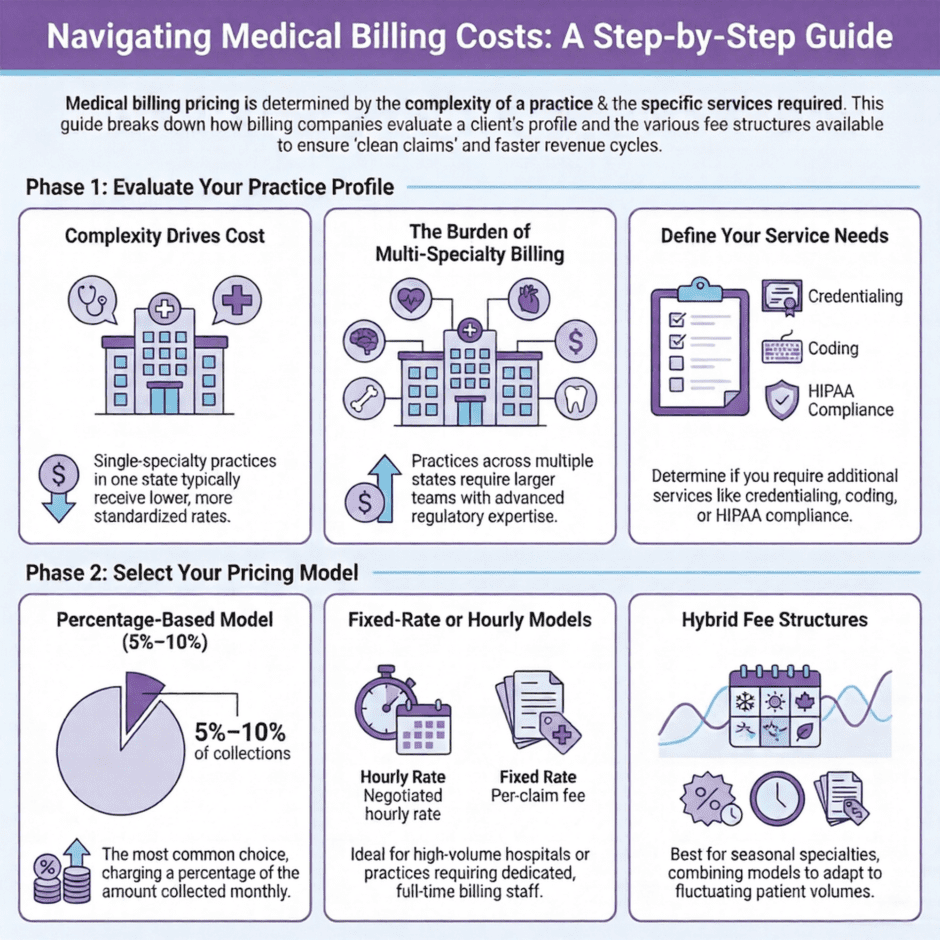
 In plain terms, the most treasured client for a medical billing company is a large healthcare practice, all operating in one medical specialty, in a single state, and performing a small volume of high-cost procedures. While no client is totally straightforward, a client with these characteristics would produce the most clear-cut, easy-to-manage amount of work for the billing company.
The more standardized the work, the easier it is to administer. On the other hand, a multi-state, multi-specialty medical practice will most likely interact with various insurance payers and considerably more rules and regulations. As a consequence, managing the work is going to take a bigger team with added know-how, and thus, burden the billing company with more costs. It’s that simple and a common reality for practices that are more challenging to manage.
Truth is, the majority of practices fall somewhere in-between. The closer you are to the ideal client, the lower the rate you can expect. The farther you plunge to suboptimal, the higher the rate you can expect.
Certain healthcare providers, such as solo practitioners, often struggle to find medical billing company that will take them on as a client. Many billing companies just can’t afford to take on specific clients, especially new practices. For example, if you’re a solo psychologist in need of fairly wide-ranging behavioral health billing, a billing company may have to charge more. And, regrettably, many solo therapists can’t afford to pay that added cost.
How do Medical Billing Companies Charge Providers?
- Percentage basis:
Under this model, the medical billing company will charge a specific percentage on the amount collected each month. Typically, the average percentage is between 5 and 10 percent, contingent on patient volume, types of cases managed and the number of receivables. - Hourly rate basis:
Some billing services offer medical billing services on an hourly rate basis. This technique is reasonable for large-scale practices and hospitals with consistent claims, and where generally an equal number of claims is managed each hour. Typically, billing companies will employ staff devoted to one client under this model. The hourly rate would differ from client to client and be determined in the course of negotiations. - Fixed rate per claim basis:
Some medical billing companies might provide a fixed rate for each claim. Thus, the rates are based on the number of claims handled rather than the amount collected. The rates charged would be contingent on the intricacy and the average amount per claim. - Hybrid fee basis:
Finally, there’s the hybrid fee model. Essentially, a hybrid is a combination of any of the aforementioned models. This fee basis is dynamically-driven based upon a healthcare provider’s needs. You might benefit from a hybrid fee model, if you see patients during one part of the year and not during another part. For example, if you’re an allergist, in need of allergy testing billing, your client volume is probably much higher during spring and summer, rather than fall or winter.
Generally speaking, a percentage-based option is the basis of most medical billing fees. We believe it’s the optimum choice for healthcare practices of all types.
In the end, hiring a billing company really comes down to what matters most to the client:
- What level of service do you anticipate?
- How much patient volume do you have?
- How significant is accuracy to your cash flow? Or, to put another way, how costly are denials?
- Do you look for the billing service to manage coding, claims appeals, credentialing, patient collections, etc.?
- Beyond just billing, do you need assistance with HIPAA compliance, pre-authorizations, etc.?
- Are you concerned whether your billing team is in the U.S. or overseas?
These are just a few of the questions you’ll want to ask. There are plenty of billing services out there. It’s the medical provider’s task to work out both the quantity and quality of service(s). The soundest advice that we can provide is to take a medical billing company’s words to heart. In other words, listen to how they present themselves and keep an eye on their on-board process.
Medical Billing Pricing FAQ
What factors determine medical billing service rates
Rates depend on how standardized a practice’s work is for the billing company to manage. A large practice in one specialty and one state with a small volume of high-cost procedures usually gets lower rates. A multi-state, multi-specialty practice dealing with many payers and rules typically faces higher rates because it needs a bigger, more skilled team.
Why do solo practitioners often pay more for medical billing services
Solo practitioners and new practices often present less predictable, smaller volumes of work that cost billing companies more to administer per claim. Some specialties, such as behavioral health, also require wider-ranging billing knowledge, which raises the price further. Many billing companies avoid these clients altogether because the work isn’t cost effective at a low rate.
How does percentage-based medical billing pricing work
Under a percentage basis, the billing company charges a set percentage of the amount collected each month, generally between 5 and 10 percent. The exact rate depends on patient volume, the types of cases handled, and the number of receivables. Practices with higher collections and simpler claims tend to see lower percentage rates.
When does an hourly rate model make sense for medical billing
An hourly rate model works well for large practices and hospitals that submit a steady, consistent number of claims. Billing companies often assign dedicated staff to a single client under this setup. The hourly rate itself is set through direct negotiation between the provider and the billing company.
What is a fixed rate per claim billing model
In a fixed rate per claim model, the billing company charges a set fee for each claim processed instead of a percentage of collections. The rate charged is based on the difficulty of the claim and its typical dollar amount. This model shifts the pricing focus from total revenue collected to claim volume and claim type.
Who benefits most from a hybrid fee billing model
A hybrid fee model combines percentage, hourly, and per-claim pricing to fit a provider’s specific patterns of work. It suits practices with uneven patient volume across the year, such as an allergist handling seasonal allergy testing billing. The mix of pricing methods adjusts to changing claim volume rather than locking a provider into one fixed structure.
How Medwave’s Billing Service Benefits Your Practice
 Most healthcare providers want paid within a few weeks for rendering their services, rather than months. The fact of the matter, when there are errors in your billing procedures, it can take months to obtain payment. Hence, when clean claims are processed, they will most likely get paid within weeks. Our motto is simple, “Get the claim out the door clean the first time.” Remember, when you consider outsourcing, you agree to specialists assuming the tasks where errors can be costly.
Medwave professionals are trained and re-trained due to the dynamic changes in the industry. Regarding new codes, dated codes, modifiers and more. For payment, all of those items must be taken into consideration for each claim submission. For a healthcare provider, billing is one of the most crucial components. A sizable portion of your practice’s income is the result of a having a top-notch medical biller in your corner.
We understand that outsourced medical billing can be a big change for any healthcare provider, even new practices (who we take on as clients). Making the wrong decision on a 3rd party service can be risky. We simplify and make the transition as transparent as possible.
Contact us below, we’ll be delighted to answer any and all medical billing service questions.

Co-Founder and COO of Medwave, bringing more than 25 years of hands-on experience in healthcare revenue cycle management, payer contracting, and medical credentialing.