

Revenue cycle management stands as one of the most critical operational functions for any business that depends on consistent cash flow. Whether you’re running a medical practice, managing a subscription service, or operating a professional services firm, the way you handle revenue generation from initial customer contact through final payment collection can make or break your financial stability. Yet despite its importance, revenue cycle management often presents significant hurdles that can disrupt operations and strain resources.
 The reality is that businesses across industries struggle with similar revenue cycle challenges. Inaccurate invoicing, delayed payments, inefficient collection processes, and billing disputes that seem to multiply rather than resolve. These issues consume valuable time and resources that could be better spent on core business activities and customer service improvements.
For healthcare organizations in particular, revenue cycle management takes on additional layers of intricacy due to insurance claims processing, regulatory compliance requirements, and the need to coordinate payments from multiple sources including insurance companies and patients themselves. But the fundamental principles and challenges remain consistent across sectors: businesses need reliable systems to track revenue, process payments accurately, and maintain healthy cash flow.
What Revenue Cycle Management Really Means
Revenue cycle management encompasses every step involved in generating and collecting revenue, from the moment a potential customer expresses interest in your services through the final payment posting. This process includes activities like customer onboarding, service delivery documentation, invoicing, payment processing, and resolving any billing discrepancies that arise along the way.
 The goal isn’t just to get paid, it’s to create a predictable, efficient system that minimizes revenue loss and ensures payments arrive accurately and on schedule. Effective revenue cycle management provides businesses with the financial stability needed to invest in growth, maintain quality service delivery, and weather unexpected economic challenges.
In healthcare settings, this process becomes particularly detailed due to the involvement of multiple payment sources and regulatory requirements. Healthcare providers must manage patient registration, insurance verification, service documentation, medical coding, claims submission, and payment posting from both insurance companies and patients. Each step in this process presents opportunities for errors or delays that can significantly impact cash flow.
However, revenue cycle management extends far beyond healthcare. Software-as-a-Service companies manage subscription billing cycles and renewals. Professional services firms track billable hours and project milestones. Manufacturing companies coordinate order processing with production schedules and shipping logistics. Educational institutions handle tuition payments and financial aid processing. Regardless of industry, the core objective remains consistent: maintaining steady revenue flow that supports business operations and growth.
The Five Major Revenue Cycle Management Challenges
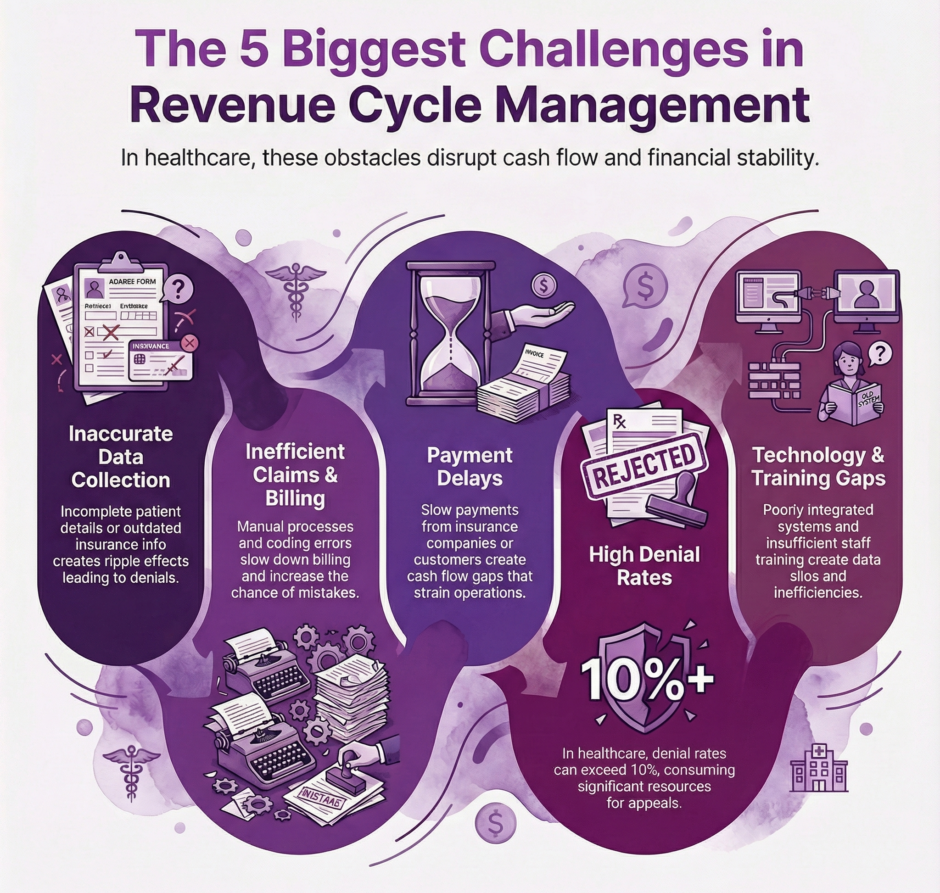
Challenge 1: Inaccurate Data Collection and Documentation
The foundation of effective revenue cycle management rests on accurate data collection from the very first customer interaction. When patient registration information is incomplete, insurance details are outdated, or service documentation is missing critical details, the entire revenue cycle suffers. These data quality issues create ripple effects that can delay payments for weeks or months.
Healthcare providers face particular challenges with patient registration accuracy. Incorrect demographic information, outdated insurance details, or missing authorization numbers can result in claim denials that require extensive rework. Similarly, businesses in other industries struggle with incomplete customer information that complicates invoicing and payment processing.
The solution requires implementing robust data collection protocols at every customer touchpoint. This means training staff on proper information gathering techniques, using technology to validate data in real-time, and establishing regular audits to identify and correct data quality issues before they impact revenue collection.
Challenge 2: Inefficient Claims Processing and Billing
 Once accurate data is collected, the next major hurdle involves translating services into billable claims or invoices. Healthcare organizations must convert clinical documentation into standardized medical codes, ensure proper authorization documentation is attached, and submit claims through appropriate channels. Other businesses face similar challenges in accurately documenting services provided and generating invoices that reflect actual work completed.
Timing plays a crucial role in this process. Healthcare claims submitted late may face automatic denials, while businesses in other sectors may lose leverage for prompt payment when invoices are delayed. Manual processes often create bottlenecks that slow down billing cycles and increase the likelihood of errors.
Technology solutions can dramatically improve billing efficiency. Automated coding systems help healthcare providers translate clinical documentation into proper billing codes. Customer relationship management platforms help other businesses track service delivery and generate accurate invoices. The key is implementing systems that reduce manual intervention while maintaining accuracy and compliance standards.
Challenge 3: Payment Delays and Cash Flow Disruption
Even when claims and invoices are submitted accurately and promptly, payment delays remain a persistent challenge across industries. Insurance companies may take weeks to process healthcare claims, while business customers often extend payment terms beyond agreed-upon schedules. These delays create cash flow gaps that can strain operations and limit growth opportunities.
Healthcare providers face additional payment challenges due to the involvement of multiple payment sources. Insurance companies may approve partial payments, requiring providers to bill patients for remaining balances. Coordinating these multiple payment streams while maintaining accurate account records requires sophisticated tracking systems and dedicated staff resources.
Proactive payment management strategies can help address these delays. This includes implementing automated payment reminders, offering multiple payment options to customers, and establishing clear payment terms upfront. Healthcare organizations benefit from robust insurance verification processes that identify potential payment issues before services are rendered.
Challenge 4: Denial Management and Appeals Processing
 Claim denials represent one of the most frustrating aspects of revenue cycle management, particularly in healthcare settings where denial rates can exceed 10% of all submitted claims. These denials often stem from coding errors, missing documentation, or authorization issues that could have been prevented with proper upfront processes.
The appeals process for denied claims consumes significant administrative resources. Staff must research denial reasons, gather supporting documentation, and resubmit claims through appropriate channels. This rework not only delays payment but also diverts resources from other revenue cycle activities.
Other industries face similar challenges with invoice disputes and payment rejections. Customers may refuse payment due to service quality concerns, billing discrepancies, or authorization issues. Resolving these disputes requires dedicated staff time and often involves lengthy negotiation processes.
Effective denial management requires both prevention and response strategies. Prevention involves implementing quality control measures throughout the revenue cycle to reduce errors before claims submission. Response strategies include establishing dedicated denial management teams, implementing tracking systems to monitor appeal status, and developing standardized processes for different types of denials.
Challenge 5: Technology Integration and Staff Training
Modern revenue cycle management relies heavily on technology solutions, but implementing and maintaining these systems presents ongoing challenges. Healthcare organizations must integrate electronic health records with billing systems, claims processing platforms, and payment posting tools. Other businesses need seamless connections between customer management systems, invoicing platforms, and accounting software.
Technology integration issues often create data silos where information doesn’t flow smoothly between systems. This leads to manual data entry, increased error rates, and inefficient workflows that slow down the entire revenue cycle. Staff members may struggle to adapt to new technologies, particularly when training is insufficient or system interfaces are poorly designed.
The solution requires careful technology selection that prioritizes integration capabilities / interoperability through HL7 / FHIR and user-friendly interfaces. Staff training must be ongoing rather than one-time events, with regular updates as systems change and improve. Organizations that invest in proper technology implementation and staff development typically see significant improvements in revenue cycle efficiency.
Key Elements of Healthcare Revenue Cycle Management
Healthcare organizations deal with particularly detailed revenue cycle management processes due to regulatory requirements and multiple payment sources.
Here are the essential components that healthcare providers must manage effectively:
- Patient Registration: This involves collecting demographic information, insurance details, and medical history to ensure accurate claims processing. Proper registration sets the foundation for the entire revenue cycle by establishing patient identity and insurance coverage verification.
- Insurance Verification and Authorization: Healthcare staff must confirm insurance coverage eligibility and obtain necessary authorizations before providing services. This step prevents claim denials and ensures patients receive appropriate coverage for their treatments.
- Charge Capture: All billable services and procedures must be accurately recorded during patient visits. Missing charges represent lost revenue that cannot be recovered after the fact.
- Medical Coding: Clinical documentation must be translated into standardized codes for billing purposes. Accurate coding ensures appropriate reimbursement and reduces the risk of claim denials.
- Claims Submission: Claims must be submitted promptly and accurately to insurance companies through electronic systems. Timing is critical, as late submissions may face automatic denials.
- Payment Posting: Payments from insurance companies must be applied correctly to patient accounts. This requires careful attention to explanation of benefits documents and proper handling of partial payments.
- Denial Management: Denied claims must be researched, corrected, and resubmitted through appropriate appeals processes. This requires dedicated staff and tracking systems to ensure timely follow-up.
- Patient Billing and Collections: Patients must be billed for remaining balances after insurance payments. This includes offering payment plans and following up on overdue accounts.
- Reporting and Analytics: Performance metrics must be tracked to identify trends and opportunities for improvement throughout the revenue cycle
Strategies for Overcoming Revenue Cycle Challenges
Addressing revenue cycle management challenges requires a multi-faceted approach that combines process improvements, technology solutions, and staff development. Organizations that take a systematic approach to these challenges typically see measurable improvements in cash flow and operational efficiency.
 Process standardization plays a crucial role in reducing errors and improving efficiency. This means documenting best practices for each step in the revenue cycle, training staff on proper procedures, and implementing quality control measures to catch errors before they impact revenue collection. Regular process reviews help identify opportunities for improvement and ensure procedures remain current with changing regulations and business requirements.
Technology implementation can automate routine tasks and reduce manual errors throughout the revenue cycle. However, technology alone isn’t sufficient, it must be properly configured, integrated with existing systems, and supported by adequate staff training. Organizations benefit from choosing solutions that can grow with their needs and adapt to changing business requirements.
Staff development remains critical for long-term revenue cycle management success. This includes initial training on proper procedures, ongoing education about regulatory changes, and cross-training to ensure coverage during absences or staff turnover. Regular performance feedback helps staff members improve their skills and contributes to overall revenue cycle efficiency.
Summary: Managing the Biggest Challenges in Revenue Cycle Management
 Revenue cycle management will continue to face new challenges as business models change, regulations evolve, and customer expectations shift. Organizations that build flexible, efficient revenue cycle management systems position themselves for long-term success regardless of these changing conditions.
The key is to view revenue cycle management as an ongoing strategic initiative rather than a routine administrative function. This means regularly evaluating performance metrics, identifying improvement opportunities, and investing in the people and technology needed to maintain efficient operations.
Healthcare organizations, in particular, benefit from working with specialized partners who understand the unique challenges of medical billing and revenue cycle management. Companies like Medwave, which offer billing, credentialing, and payer contracting services, can help healthcare providers optimize their revenue cycles while focusing on patient care delivery.
Contact us to manage all of your revenue cycle management needs and/or challenges.