

The work history section of your CAQH profile causes more credentialing delays than any other part of the application. It’s not because the concept is difficult. You simply list where you’ve worked for the past ten years, right? The problem is that CAQH demands a complete, gap-free accounting of your professional life, and most providers don’t realize how strictly this requirement is enforced until their credentialing grinds to a halt.
Insurance companies need to verify that you have continuous, legitimate professional activity without unexplained absences. When they see gaps in your work history, red flags go up. Did you lose your license? Were you under investigation? Did you leave medicine temporarily? These questions need answers, and until you provide them, your credentialing won’t move forward.
The good news is that legitimate employment gaps are perfectly acceptable once you document them properly. The bad news is that figuring out what CAQH considers a “gap” and how to explain it correctly isn’t always obvious.
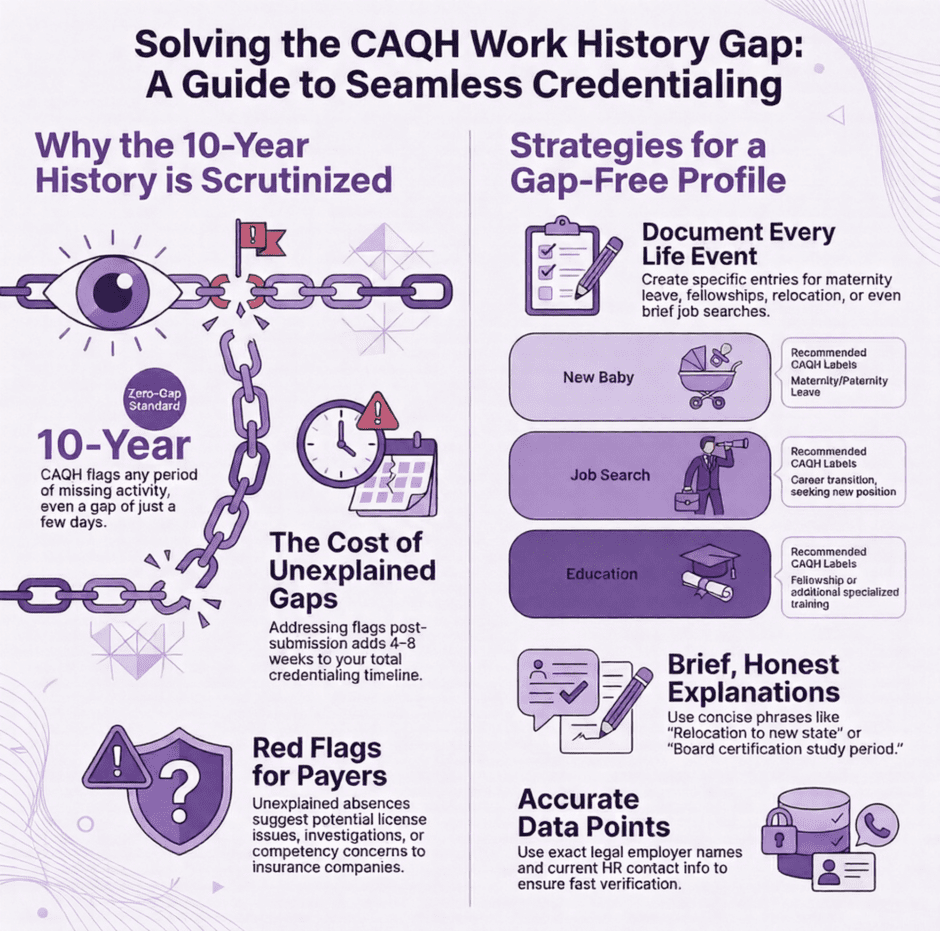
Why Work History Creates the Most Problems

Your CAQH work history tells insurance companies whether you’ve been continuously active in healthcare and whether you have the experience necessary to provide quality care. It’s one of the most scrutinized sections because it reveals patterns that might indicate problems.
Most physicians and healthcare providers have taken time off at some point. You might have completed additional training, started a family, dealt with a personal health issue, or simply transitioned between positions. None of these situations disqualify you from credentialing, but all of them require clear documentation in your CAQH profile.
The challenge is that CAQH’s system flags any period of time not accounted for in your employment history. Even a gap of just a few weeks between positions can trigger verification delays. Insurance companies then send requests for clarification, your application sits in pending status, and weeks turn into months while you try to figure out what they need.
What CAQH Work History Requirements Actually Mean
CAQH requires a complete work history covering the past ten years from your current date. This means listing every position you’ve held, including the exact start and end dates, your role, the employer’s name and address, your supervisor’s contact information, and whether the position was full-time or part-time.
The system performs an automatic calculation. It looks at your first listed position and your last listed position, then checks whether those dates span a continuous ten-year period without gaps. If March 15, 2016 to March 15, 2026 should be covered and you only have employment listed through December 2025, that’s a gap. If you show employment ending in June 2019 and starting again in January 2020, that’s a gap.
Here’s what trips up many providers. CAQH counts calendar days, not just employment periods. If you finished one job on a Friday and started another the following Monday, those weekend days technically create a gap unless the dates align perfectly. While most credentialing specialists won’t flag a gap of just a few days, the system’s literal interpretation means you need to be precise.
Every position must include verifiable information. CAQH or the insurance companies will contact your former employers to confirm you actually worked there during the dates you listed. If the phone number you provided is disconnected or the contact person left years ago, verification fails. Your application stalls while they track down someone who can confirm your employment.
What Actually Counts as a Gap in Employment

A gap is any period of time within the past ten years where you don’t have documented professional activity. This is broader than just unemployment. Even if you were busy with other things, CAQH needs to know what those things were.
If you completed your residency in June 2019 and started your first attending position in September 2019, those three months are a gap even though you might have been studying for boards, moving, or preparing to start work. You need to document what you were doing during that time.
Career transitions often create gaps. Maybe you left one practice and took a month to interview at several locations before accepting a new position. Perhaps you resigned from a hospital and spent six weeks setting up your own practice before seeing your first patient. These are legitimate activities, but they’re still gaps until you explain them in your CAQH profile.
Even very short periods matter. Some providers assume that a two-week gap between jobs isn’t worth mentioning. However, credentialing committees reviewing your application don’t know whether that two-week gap was intentional or whether you’re hiding something. Document everything to avoid questions.
How to Document Legitimate Gaps
The key to handling employment gaps is being proactive. Don’t wait for an insurance company to flag the gap and request explanation. Address it upfront in your CAQH profile by adding an entry that covers the gap period.
Maternity and Paternity Leave
Taking time off after the birth or adoption of a child is one of the most common legitimate gaps. CAQH has a specific category for this. When you add a gap entry, select “Maternity/Paternity Leave” as the reason, provide the exact dates you were on leave, and briefly note “Maternity leave following birth of child” or similar.
If you took leave through your employer’s program, you might still list that employer for the gap period and note that you were on approved leave. If you left your position to have a child and didn’t return to that employer, create a separate gap entry. Either approach works as long as the dates are covered and the explanation is clear.
Fellowship or Additional Training
Additional medical training is another common and completely acceptable reason for gaps. If you completed a fellowship, pursued additional certifications, or went back for specialized training, document it clearly.
Create an entry that shows the training program name, the dates you attended, the type of training, and the credential or knowledge you gained. “Fellowship in Interventional Cardiology, University Hospital, July 2018 to June 2019” gives credentialing committees everything they need. Include the program director’s contact information for verification purposes.
Some providers complete mini-fellowships, weekend courses, or short-term training that creates brief gaps. These still need documentation. Even a two-week intensive course should be listed if it falls between employment periods.
Career Transition Periods
Sometimes you simply need time between jobs. You might have been searching for the right opportunity, relocating to a new city, or dealing with personal circumstances that prevented immediate re-employment. These situations are normal, and credentialing committees see them regularly.
Be honest but brief. “Career transition, seeking new position” or “Relocation from [State] to [State], seeking local employment” explains the situation without oversharing. Provide the dates the gap covers and move on. You don’t need to explain every detail of your job search or personal circumstances.
If the gap is longer than six months, consider providing slightly more context. “Personal leave to care for family member” or “Extended job search due to specific location requirements” helps credentialing committees feel comfortable that you were making reasonable decisions rather than being unable to find work due to competency concerns.
Time Off for Personal Reasons
Health issues, family obligations, or simply needing a break from medicine are all legitimate reasons for employment gaps. How you document these depends on the specific situation and what you’re comfortable sharing.
For health-related gaps, you can be vague. “Medical leave for personal health issue, fully recovered” conveys that you took time off for health but are now able to practice without restriction. You’re not required to disclose specific diagnoses unless they impact your current ability to practice safely.
If you took time off to deal with family obligations like caring for an aging parent or dealing with a divorce, a simple “Personal leave for family obligations” suffices. Again, you don’t need extensive details. The goal is to show that the gap was intentional and not the result of professional discipline or inability to maintain employment.
Military Service
Active military service is straightforward to document and highly respected by credentialing committees. List your branch of service, your rank, the dates of service, and your role. If you provided medical services during your military time, note that clearly. “U.S. Army, Captain, Flight Surgeon, providing emergency and preventive medical care, January 2017 to January 2020” shows continuous professional activity even though it might not have been traditional civilian employment.
Reserve duty or National Guard service that you performed while maintaining civilian employment doesn’t typically create gaps, but it’s still worth noting in your work history if it was a significant time commitment.
Common Work History Documentation Errors That Cause Delays
 Beyond unexplained gaps, several specific mistakes trip up providers when completing the work history section.
Listing incomplete dates is surprisingly common. You might remember you started a job in “Spring 2018” but can’t recall the exact date. CAQH requires month and year at minimum. Putting “00/2018” or leaving the day field blank can cause verification issues. Check old tax documents, offer letters, or contact HR departments to get precise dates.
Inaccurate employer information creates verification headaches. If you list “City Hospital” but the legal entity name is “Metropolitan Healthcare System d/b/a City Hospital,” the verification might fail. Use the exact legal name of the organization. Similarly, if the main hospital number goes to a general operator who can’t verify employment, provide the direct number for HR or medical staff services.
Supervisor names pose another challenge. You might list Dr. Smith as your supervisor, but if Dr. Smith left that organization five years ago, verification becomes difficult. Include current contact information for the department rather than relying on a specific person who might not be reachable.
Vague position descriptions create questions. “Physician” doesn’t tell credentialing committees much. “Emergency Medicine Physician, 12-hour shifts covering Level II trauma center, avg 35 patients per shift” provides context about your experience and responsibilities. More detail prevents follow-up questions.
Handling Overlapping Positions
Many physicians work multiple positions simultaneously. You might have a primary hospital job while also working per diem shifts at another facility, maintaining a small private practice, or serving as medical director for a nursing home. These overlapping positions are perfectly normal but need to be documented correctly.
List each position separately with accurate dates, even if they overlap. Make it clear which position was your primary role and which were secondary or per diem positions. Use the “hours per week” or “full-time/part-time” fields to show that you weren’t somehow working 80 hours per week at two different full-time jobs.
For example, you might list:
- Hospital A, Emergency Medicine, Full-time (40 hrs/week), Jan 2020 to Present
- Urgent Care B, Physician, Per Diem (8-16 hrs/week), March 2021 to Present
This makes it clear you had one primary position and picked up additional shifts elsewhere. Without this clarity, credentialing committees might question how you managed both or whether the dates are errors.
Part-Time vs. Full-Time Position Documentation

CAQH asks you to specify whether positions were full-time or part-time. This matters because a credentialing committee wants to see consistent professional activity. A series of very part-time positions with large unexplained gaps between them raises more questions than steady full-time employment.
If you worked part-time, be honest about it. Indicate approximately how many hours per week or how many shifts per month. “Part-time, 2 shifts per week” or “Part-time, approximately 16 hours per week” gives committees what they need.
If part-time work was your only employment during a period, make sure the dates don’t create the appearance of gaps. If you worked two shifts per week at a clinic from January to December 2021, list those dates as January 2021 to December 2021 and note the part-time status. Don’t list just the specific dates you worked, which would create the appearance of multiple gaps.
What to Do When You Can’t Remember Exact Dates
Ten years is a long time, and remembering exactly when you started or ended every position isn’t always easy. There are several strategies for reconstructing your work history when your memory is fuzzy.
Start with tax documents. Your W-2 forms show which employers paid you each year. If you have old tax returns, they provide a rough timeline of your employment. You might not get exact start and end dates, but you’ll know which years you worked at each place.
Contact HR departments at your former employers. Most organizations maintain employment records for many years and can provide verification of your dates of employment. Some charge a small fee for this service, but it’s worth it to get accurate information.
Check old emails. If you still have access to email accounts from your previous positions, search for your first day’s welcome email or your resignation correspondence. These messages often include specific dates.
Look at your CV or old job applications. Many providers keep outdated versions of their CV that include dates they later forgot. Old applications for hospital privileges or insurance credentialing might also have the dates you need.
If you absolutely cannot determine exact dates, use your best estimate and note that in CAQH. “Approximate dates, employer records requested for verification” shows you’re being honest about uncertainty rather than guessing wildly. However, make every effort to get precise dates before resorting to estimates.
How Locum Tenens Work Fits into CAQH
 Locum tenens assignments create special documentation challenges. You might have worked at five different facilities over a two-year period, each for one to three months. Listing every single assignment separately is tedious but necessary for complete work history.
Each locum assignment should be listed as a separate position with the specific facility name, location, your role, and the exact dates you worked there. If you worked through a locum tenens staffing agency, you can list the agency as the employer but should still note which facility you actually worked at in the position description.
Some providers worry that multiple short-term positions look bad, but credentialing committees are familiar with locum work. What looks bad is unexplained gaps between locum assignments. If you had a month off between two locum jobs, document it as “Between locum assignments, available for new placement” or similar.
If you work frequent locums, keep detailed records as you go. Track each assignment’s start date, end date, facility name, contact person, and any relevant details. Trying to reconstruct a complicated locum history years later is extremely frustrating.
How to Verify Your Work History Is Complete
Before you attest to your CAQH profile, verify that your work history section is truly complete and gap-free. Here’s a systematic approach.
Print your work history section and spread it out where you can see all positions at once. Look for any time periods not covered by a listed position. Calculate the gaps manually rather than assuming CAQH’s system caught everything.
Create a timeline on paper if needed. Draw a line representing the past ten years and mark each employment period. Visual representation makes gaps obvious. Any white space on your timeline is a gap that needs documentation.
Check that start and end dates align logically. If one position ended in March and the next started in April, you’re fine. If one ended in March and the next started in June, where were you in April and May?
Verify that the total time covered actually spans ten full years. Count backward from today’s date ten years. Does your earliest listed position or explained gap reach back that far? If not, you need to list earlier employment or explain what you were doing before that.
Ask a colleague to review your work history. Sometimes a fresh set of eyes catches gaps or inconsistencies you missed. A practice manager or credentialing specialist can often spot problems quickly.
What Happens If You Leave Gaps Unaddressed
 Ignoring gaps in your work history doesn’t make them go away. It just ensures they’ll become problems later in the credentialing process when fixing them is more disruptive.
When an insurance company pulls your CAQH information and notices gaps, they send a request for additional information. Your application status changes to “pending additional information” and doesn’t move forward until you respond. The insurance company won’t process other parts of your application while this is unresolved. Everything stops.
You’ll receive a letter or email asking you to explain specific gaps. You then need to log back into CAQH, add the missing information, re-attest to your profile, and notify the insurance company that you’ve made corrections. This back-and-forth easily adds four to eight weeks to your credentialing timeline.
Some insurance companies are less patient than others. If you don’t respond promptly to requests for gap clarification, they might simply deny your credentialing application. You’d then need to reapply from scratch, adding months to the process.
The gaps themselves rarely cause problems. The lack of explanation causes problems. Insurance companies don’t care that you took six months off between jobs. They care that you didn’t bother to mention it, which makes them wonder what else you’re not mentioning.
Real Examples of Work History Mistakes and How to Fix Them
4 Examples of of Work History Mistakes + Fixes
Let’s look at actual scenarios that cause credentialing delays and how to resolve them:
- Example 1: The Residency Gap
Dr. Mueller completed her family medicine residency on June 30, 2020. She started her first attending physician position on September 1, 2020. She didn’t list anything for July and August 2020, creating a two-month gap.
The fix: Add an entry for July 1, 2020 to August 31, 2020 labeled “Post-residency preparation period, studying for board certification exam and relocating for new position.” This explains the gap and shows it was intentional. - Example 2: The Baby Gap
Dr. Patel stopped working in March 2019 when she was eight months pregnant. She returned to work in January 2020, ten months later. She listed her employment as ending in March 2019 and starting again in January 2020 without explanation.
The fix: Add an entry for April 2019 to December 2019 labeled “Maternity leave following birth of child.” She doesn’t need to specify that she took longer than typical maternity leave or explain her decisions. The dates and basic explanation are sufficient. - Example 3: The Practice Change Mystery
Dr. Rodriguez shows employment at Hospital A ending December 2021 and employment at Clinic B starting February 2022. He doesn’t explain January 2022.
The fix: Add an entry for January 2022 labeled “Career transition, interviewing and negotiating new position.” One month between jobs is completely normal and unremarkable once it’s documented. - Example 4: The Overlapping Jobs Confusion
Dr. Williams lists full-time employment at Practice A from 2018 to present and full-time employment at Hospital B from 2020 to present. The credentialing committee questions how he works two full-time positions simultaneously.
The fix: Correct the Hospital B entry to show “Per diem, approximately 2 shifts per month (16 hours/month)” instead of full-time. This clarifies that Hospital B is supplemental to his primary position at Practice A.
How Credentialing Specialists Handle Work History Issues
 Professional credentialing services exist partly because the work history section is so prone to errors and delays. At Medwave, we specialize in medical billing, credentialing, and payer contracting, and we’ve seen every possible work history complication.
Credentialing specialists interview providers thoroughly about their employment history before entering anything into CAQH. They ask specific questions about periods between jobs, why you left certain positions, whether you worked anywhere that’s not on your CV, and whether there are any gaps in the timeline.
They also verify employer information before submitting applications. If a hospital closed five years ago, credentialing specialists know to list the successor organization or explain the closure in the work history. They track down current phone numbers for verification contacts and know which hospitals have specific processes for employment verification.
When gaps exist, experienced credentialing specialists know exactly how much explanation is needed. They strike a balance between providing enough information to satisfy credentialing committees and avoiding oversharing personal details that aren’t relevant. They’ve seen thousands of work histories and know what raises red flags versus what’s completely normal.
Perhaps most importantly, credentialing specialists catch work history errors before applications are submitted. Fixing problems during the initial CAQH setup takes minutes. Fixing problems after an insurance company flags them takes weeks. This proactive approach is why professionally managed credentialing usually proceeds much faster than self-managed credentialing.
Complete Work History Equals Faster Credentialing
 Your work history might feel like tedious paperwork, but it’s one of the most important parts of your credentialing application. Insurance companies need assurance that you’ve been continuously active in healthcare and that you have appropriate experience for the services you’ll provide.
The key is being thorough and proactive. Don’t wait for gaps to become problems. Document everything upfront, provide clear explanations for any time periods not spent in traditional employment, and verify that your timeline is truly continuous before attestation.
Most work history problems arise from providers rushing through the section or assuming that small gaps don’t matter. Take the time to get it right. Check old records, contact former employers for date verification if needed, and create gap entries for any periods not otherwise covered. The hour you spend perfecting your work history saves weeks of delay later.
If you’re unsure whether your work history is complete or how to explain certain gaps, consider working with credentialing specialists who handle these issues daily. The investment in professional credentialing support pays for itself through faster approval, fewer headaches, and the peace of mind that comes from knowing your application is correct. This enables you to avoid CAQH application mistakes.
Your career path might not be perfectly linear. You might have taken detours, pursued additional training, started a family, or dealt with personal circumstances that required time away from practice. None of these things disqualify you from credentialing. What matters is documenting your path clearly so insurance companies can verify your qualifications and approve your application.
Get your work history right, and everything else in the credentialing process becomes easier.