

If you’re a healthcare provider trying to get credentialed with insurance companies, you’ve probably heard about CAQH ProView. This online database helps streamline the credentialing process by allowing you to enter your information once and share it with multiple payers. Sounds simple enough, right? The reality is that small mistakes in your CAQH application can add weeks or even months to your credentialing timeline, costing you thousands of dollars in lost revenue.
Every day you’re not credentialed is a day you can’t bill insurance for the services you provide. You might have to turn away patients, accept reduced self-pay rates, or simply work for free while waiting for approval. The good news is that most CAQH errors are preventable when you know what to watch for.
Why CAQH Errors Cost You Money
 Before we dive into specific mistakes, let’s talk about what’s actually at stake. When you submit an incomplete or incorrect CAQH profile, insurance companies can’t complete their verification process. They either send the application back to you for corrections or simply let it sit in limbo until you figure out the problem.
The average credentialing process takes 90 to 120 days under normal circumstances. When errors exist in your CAQH profile, that timeline can stretch to six months or longer. For a physician earning $200,000 annually, a three-month delay represents roughly $50,000 in lost billing opportunities. Even if you’re seeing patients during this time, you’re either not getting paid at all or receiving significantly reduced payments.
The cost goes beyond just lost revenue. Your front desk staff spends time explaining to frustrated patients why you can’t accept their insurance yet. You might need to hire additional staff or pay overtime to handle the extra administrative burden. And perhaps most importantly, you risk damaging your reputation when patients have negative experiences trying to access your care.
The 15 Most Common CAQH Application Mistakes
Let’s walk through the errors that trip up providers most frequently. Recognizing these problems before you submit your application can save you significant time and frustration.
1. Incomplete Work History Gaps
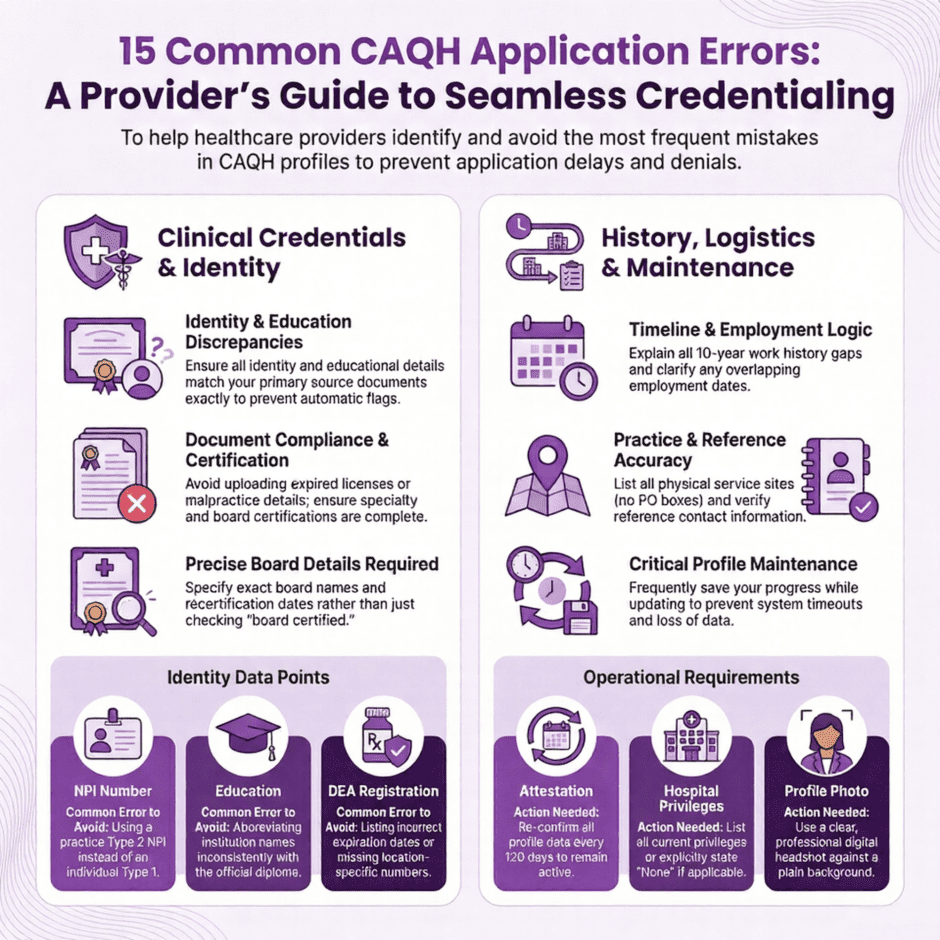
CAQH requires a complete account of your professional activities for the past ten years with no unexplained work gaps. This is where many providers run into trouble. If you took time off for maternity leave, additional training, a career transition, or personal reasons, you need to document it. Simply leaving a gap blank triggers an automatic flag that delays your application.
The system doesn’t care why you took time off, but it does need to know that the gap was intentional and legitimate. Create a clear explanation for every period when you weren’t actively practicing medicine. Include dates and brief descriptions. “Maternity leave, June 2020 to December 2020” is perfectly acceptable.
2. Missing or Expired Documents
Your CAQH profile requires supporting documentation for licenses, certifications, malpractice insurance, and other credentials. One of the most frustrating mistakes is uploading documents that have already expired or will expire soon.
Check the expiration date on every document before you upload it. If your medical license expires in two months, the insurance company processing your application three months from now will see an expired license and deny your application. You’ll need to upload the renewed license and start the verification process over again.
Similarly, missing documents entirely will halt your application. CAQH won’t alert you that you forgot to upload your DEA certificate until an insurance company requests your information and finds it missing. Set aside time to gather every required document before you start your CAQH profile.
3. Incorrect NPI Information
Your National Provider Identifier is the unique number that identifies you in the healthcare system. It seems simple enough to enter ten digits correctly, but errors happen more often than you’d think. Some providers accidentally use their practice’s Type 2 NPI instead of their individual Type 1 NPI. Others transpose digits or pull information from outdated sources.
Verify your NPI at the official NPPES website before entering it into CAQH. Make sure the name, credentials, and taxonomy code listed in NPPES match exactly what you’re putting in your CAQH profile. Even minor discrepancies can trigger verification failures.
4. Outdated Malpractice Insurance Details
Malpractice insurance changes frequently. You might switch carriers, update coverage amounts, or renew your policy. Each change needs to be reflected in your CAQH profile immediately, but many providers forget to update this information.
When an insurance company verifies your malpractice coverage, they need to see current, active policies with adequate coverage limits. If your CAQH shows a policy that expired six months ago, your credentialing stops until you upload current certificates. Even worse, some providers list coverage amounts that don’t meet the minimum requirements for certain payers, leading to automatic denials.
5. Incomplete Education Verification
Your medical education information must be complete and accurate. This includes medical school graduation dates, degree types, and institution names. Foreign medical graduates face additional documentation requirements including ECFMG certification.
Common mistakes include abbreviating institution names inconsistently, listing incorrect graduation years, or failing to upload degree copies. Make sure your medical school name matches exactly what appears on your diploma and what the school uses in official records. “University of State Medical School” might be correct while “State University School of Medicine” is wrong, even though they sound similar.
6. Wrong DEA Number or Expiration Date
If you prescribe controlled substances, you need an active DEA registration. The DEA number and expiration date you list in CAQH must be current and accurate. This seems straightforward, but errors occur when providers have multiple DEA numbers for different practice locations or when they let registrations expire without updating their CAQH profile.
Check your DEA certificate directly rather than relying on memory. Enter the number exactly as it appears, including the two-letter prefix and seven-digit suffix. Note the expiration date carefully and set a reminder to update CAQH when you renew.
7. Missing Board Certification Details
Board certification demonstrates your expertise in a specific medical specialty. If you’re board certified, CAQH needs to know which board, when you were certified, and whether your certification is time-limited or permanent.
Many providers simply check “board certified” without providing complete details. You need to specify the exact board (American Board of Internal Medicine, American Board of Family Medicine, etc.), your certification date, and your recertification date if applicable. Failing to include subspecialty board certifications also causes problems, especially when applying to specialty insurance panels.
8. Incomplete Hospital Privileges Section
The hospital privileges section asks where you have admitting or clinical privileges. Some providers leave this blank thinking it’s optional. Others list privileges they no longer hold or fail to note important details about their privilege status.
Be thorough here. List every hospital where you currently have privileges, specify the type of privileges (active staff, courtesy staff, consulting staff, etc.), and note any specialty-specific privileges. If you don’t have hospital privileges, explicitly state that rather than leaving the section blank.
9. Attestation Errors and Delays
CAQH requires you to “attest” to your profile at least every 120 days, confirming that all information remains accurate and current. Missing your attestation deadline causes your profile to go inactive, which immediately stops all pending credentialing applications.
Set up multiple reminders for your attestation deadline. Many providers miss this requirement simply because they forget. When your profile goes inactive, insurance companies can’t access your information. You’ll need to re-attest and potentially restart credentialing applications that were nearly complete.
10. Photo Requirements Not Met
CAQH requires a professional headshot photo that meets specific requirements. The photo must be recent, show your face clearly, and meet certain technical specifications for size and format. Photos that are too small, too large, blurry, or taken in poor lighting get rejected.
Use a high-quality digital photo taken against a plain background. Avoid selfies, casual photos, or images that are several years old. Your photo should look like something you’d use on a professional badge or directory listing.
11. Reference Contact Information Errors
You need to provide professional references who can verify your qualifications and character. The contact information for these references must be current and complete. Many applications get delayed when insurance companies can’t reach the references you listed.
Before listing someone as a reference, confirm they’re willing to serve in that role and verify their current contact information. Don’t use outdated phone numbers or email addresses. Make sure your references know they might be contacted so they’ll respond promptly when verification calls arrive.
12. Overlapping Employment Dates
Your work history must show a clear timeline without illogical overlaps. If you list full-time employment at Hospital A from 2018 to 2020 and full-time employment at Clinic B from 2019 to 2021, the overlap raises questions. Was one position part-time? Did you moonlight? Or is there an error in your dates?
Review your employment timeline carefully. Make sure dates don’t overlap unless you genuinely worked two positions simultaneously, in which case you should note that one was part-time or per diem. Accurate dates prevent verification delays and questions from credentialing committees.
13. Missing Specialty Certifications
Beyond board certification, you might hold additional certifications relevant to your practice. Advanced Cardiac Life Support (ACLS), Pediatric Advanced Life Support (PALS), or specialty procedure certifications all belong in your CAQH profile if they’re required for your practice.
Don’t assume these are optional. Many insurance panels require specific certifications for credentialing approval. List all relevant certifications with current expiration dates and certificate numbers when available.
14. Incorrect Practice Location Information
The practice locations you list must match where you actually see patients. Errors occur when providers list only their primary office but actually see patients at multiple locations, or when they fail to update CAQH after moving to a new office.
Each location needs complete details including the full street address, phone number, and your role at that location. PO boxes aren’t acceptable as service addresses. If you provide telehealth services, there are specific ways to document that as well.
15. Not Saving Progress Before Timeout
CAQH has session timeouts for security purposes. If you walk away from your computer while working on your profile, the system logs you out automatically. Any unsaved changes disappear, forcing you to re-enter information.
Save your work frequently as you complete each section. Don’t try to finish your entire CAQH profile in one sitting. Break it into manageable chunks, saving after each section. This prevents lost work and reduces frustration.
How Each Mistake Impacts Your Timeline
 Understanding the consequences of specific errors helps you prioritize accuracy. Not all mistakes are equal in terms of delay time.
Incorrect identifiers like NPI or DEA numbers typically add two to four weeks to your timeline while verification staff research the discrepancy and request corrections. Missing documents can add four to eight weeks, since you need to obtain and upload the documents, then wait for re-verification.
Work history gaps might add six to twelve weeks if the insurance company sends your application back for clarification and explanation. You’ll need to document the gap, resubmit the application, and wait for the verification process to start over.
Attestation lapses can be the most costly. If your CAQH goes inactive due to missed attestation, some insurance companies treat it as a withdrawn application. You might need to start the entire credentialing process from scratch, adding three to six months to your timeline.
Red Flags That Indicate Errors in Your Profile
How do you know if your CAQH profile has problems? Several warning signs suggest errors that need attention.
If you notice your credentialing applications taking significantly longer than the timeframes you were given, errors might be the culprit. When insurance companies can’t verify your information, applications simply sit without progress.
Email notifications from CAQH about “incomplete sections” or “required information missing” are obvious red flags. Don’t ignore these messages. Address them immediately to prevent delays.
If you receive calls or emails from insurance company credentialing departments asking for clarification or additional information, that indicates something in your CAQH profile isn’t clear or complete. Respond promptly with the requested information.
Check your CAQH profile status regularly. An “inactive” status means your profile can’t be accessed by insurance companies at all. A “complete” status doesn’t guarantee accuracy, but an “incomplete” status definitely means problems exist.
Step-by-Step Error Correction Process
 When you discover errors in your CAQH profile, fixing them quickly minimizes delays. Here’s how to correct mistakes efficiently.
Firstly, log into your CAQH account and review the entire profile section by section. Don’t just fix the one error you noticed. Use this opportunity to verify everything is accurate and current. Check dates, spelling, document expiration dates, and contact information throughout.
Make corrections directly in the relevant sections. CAQH allows you to edit most information at any time. For items requiring documentation, upload new or corrected documents immediately.
After making changes, review your entire profile again. Sometimes fixing one error reveals others. Make sure all sections show “complete” status with green checkmarks or similar indicators.
Re-attest to your profile after making corrections. This updates the “last attested” date and ensures insurance companies see your corrected information. Some payers won’t pull updated information until they see a new attestation date.
Contact insurance companies that have pending applications and let them know you’ve corrected errors in your CAQH profile. Don’t assume they’ll automatically check for updates. A quick phone call or email can restart stalled applications.
How to Verify Your CAQH Is Error-Free Before Attestation
Prevention beats correction every time. Before you attest to your CAQH profile, work through this verification process.
Print your entire profile and review it on paper. Reading information in a different format helps catch errors you might miss on screen. Check every date, name, number, and address carefully.
Cross-reference your CAQH information against source documents. Does your medical license number in CAQH match your actual license? Does your DEA expiration date match your certificate? Is your malpractice coverage amount what your insurance company shows?
Ask a colleague or staff member to review your profile with fresh eyes. They might catch errors or inconsistencies you’ve overlooked. A second review is especially valuable for work history and education sections where small date errors hide easily.
Verify that all uploaded documents are current, readable, and complete. Open each document in CAQH to confirm it uploaded correctly. Check expiration dates on licenses, certifications, and insurance policies.
Confirm your contact information is current. Make sure the email address and phone number in your profile are ones you check regularly. You need to receive notifications from CAQH and be reachable when insurance companies have questions.
The Real Cost of CAQH Mistakes
 Let’s put some numbers to the impact of CAQH errors. The financial consequences extend beyond just delayed revenue.
A physician earning $250,000 annually who experiences a three-month credentialing delay due to CAQH errors loses approximately $62,500 in billing opportunities. If the practice employs that physician and pays a salary, those three months represent pure expense with no revenue to offset it.
Administrative costs add up too. Staff time spent tracking down missing documents, making correction calls, and following up on delayed applications might total 20 to 40 hours per provider. At $25 per hour, that’s $500 to $1,000 in additional labor costs.
Some practices need to hire temporary staff or pay overtime to handle patient scheduling complications when new providers can’t yet bill insurance. These costs can reach several thousand dollars depending on practice size and patient volume.
Opportunity costs matter as well. Every patient you turn away because you can’t accept their insurance is a patient who might never return. Building a practice takes time, and credentialing delays slow your patient panel growth.
The stress and frustration have costs that are harder to quantify but very real. Physicians who expected to start generating revenue find themselves in financial limbo. Practice managers face uncomfortable conversations with providers asking why credentialing is taking so long.
How Credentialing Services Prevent These Mistakes
Professional credentialing services exist precisely because CAQH applications are prone to errors that cause expensive delays. At Medwave, we specialize in medical billing, credentialing, and payer contracting, helping healthcare providers avoid the common pitfalls that derail applications.
Credentialing specialists know which documentation insurance companies scrutinize most carefully. They verify information before it goes into CAQH rather than discovering errors after submission. This front-end accuracy prevents the back-and-forth that adds weeks to timelines.
Experienced credentialing staff maintain relationships with insurance company verification departments. When questions arise, they can often resolve them with a phone call rather than waiting for formal correspondence. This insider knowledge speeds the process considerably.
Credentialing services also track attestation deadlines, document expirations, and renewal requirements so nothing falls through the cracks. You don’t need to remember to re-attest every 120 days or worry about expired malpractice certificates. The service handles monitoring and updates.
For practices bringing on multiple providers or managing credentialing across several locations, professional services provide consistency and efficiency. Rather than each provider struggling through CAQH independently, one team handles everything with proven processes.
The cost of credentialing services is typically far less than the revenue lost to credentialing delays. When you factor in prevented errors, faster approval times, and reduced administrative burden, professional credentialing support often pays for itself many times over.
Conclusion: Prevention Is Cheaper Than Correction
 CAQH errors are frustrating because they’re usually preventable. The difference between a smooth 90-day credentialing process and a six-month nightmare often comes down to attention to detail when completing your initial application.
Take the time to get it right the first time. Gather all necessary documents before you start. Verify every date, number, and name as you enter information. Save frequently and review thoroughly before attestation. These simple steps prevent the majority of errors that delay credentialing.
If you’re not confident in your ability to complete CAQH accurately, or if you simply don’t have time to manage the details, professional help is available. The investment in credentialing services returns dividends through faster approvals, fewer headaches, and the ability to focus on patient care instead of administrative paperwork.
Your time is valuable. Every hour spent troubleshooting CAQH errors is an hour not spent seeing patients, growing your practice, or enjoying time away from work. Make the smart choice for your practice and your sanity by handling CAQH credentialing correctly from the start.